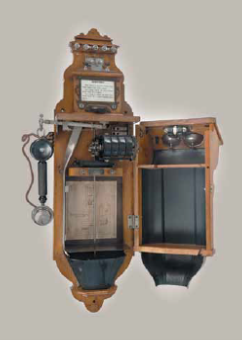
| Name | L. M. Ericsson Wall Magneto |
| Date | c. 1903 |
| Manufacturer | Russian Joint-Stock Company L. M. Ericsson & Co. at its St Petersburg telephone factory. |

L. M. Ericsson Wall Magneto
This elaborate L. M. Ericsson wall-mounted telephone represents the most advanced of Ericsson’s early coin-operated instruments supplied in the Russian Empire. Introduced from about 1903, it was manufactured by the Russian Joint-Stock Company L. M. Ericsson & Co. at its St Petersburg telephone factory. Unlike the separate Medny Pyatachok money box, this model combined the telephone and automatic payment mechanism in a single wooden wall cabinet.
Designed for manual telephone exchanges, it accepted silver 10- or 15-kopeck coins. The caller first inserted the required coin before contacting the central exchange. Pressing the button on the right dropped the coin into the collection box and activated a vibrating plate, producing a distinctive signal that informed the exchange operator that payment had been made.
Importantly, the system already incorporated a form of coin refund. If the requested line was busy, the caller operated a button on the left to release the coin. Undersized coins were rejected automatically. Each instrument was adjusted for the particular coin denomination and tariff used by the local telephone network.
These Ericsson instruments were important predecessors of the fully automatic Soviet payphone, combining telephone, payment verification and coin handling decades before dial payphones became commonplace.
Leave a Reply