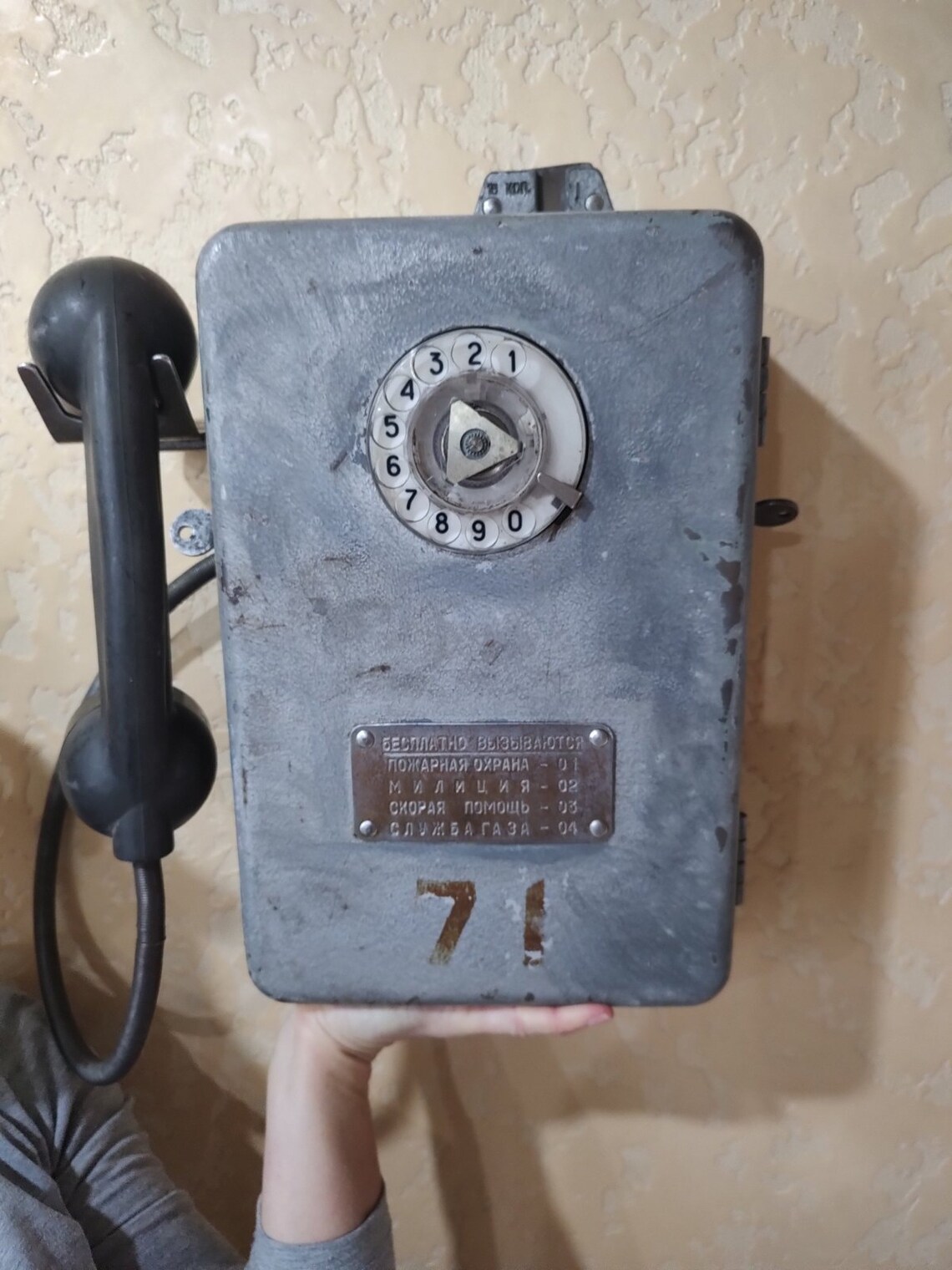
| Name | AMT-69 Soviet Payphone |
| Date | 1969 |
| Manufacturer | The AMT-69 was designed specifically for production at the Perm Telephone Plant (Permskiy Telefonnyy Zavod), one of the Soviet Union’s principal telephone-equipment factories. Sources differ slightly over the commencement of production: some indicate an initial release around 1971, while museum and Rostelecom sources give 1974 for full-scale serial production. |
| Link | Additional information at Moscow based payphone museum website- https://amt69.ru/ |

AMT-69 Soviet Payphone
The AMT-69 (АМТ-69) was the definitive Soviet public telephone and one of the most recognisable pieces of everyday industrial design in the USSR. Its name is generally expanded as Avtomaticheskiy Monetnyy Taksofon — Automatic Coin Payphone — with “69” referring to its 1969 design. It was developed by engineers at LONIIS (Leningrad Branch of the Central Research Institute of Communications) as a simpler, more economical successor to the post-war AMT-47.

The AMT-69 was designed specifically for production at the Perm Telephone Plant (Permskiy Telefonnyy Zavod), one of the Soviet Union’s principal telephone-equipment factories. Sources differ slightly over the commencement of production: some indicate an initial release around 1971, while museum and Rostelecom sources give 1974 for full-scale serial production.
Its design was uncompromisingly functional. A heavy pressed-steel, vandal-resistant case, usually finished in grey or grey-green hammer enamel, contained the coin mechanism and telephone circuitry. The front was dominated by a black rotary dial, instruction plate, coin slot and substantial black carbolite handset, connected by an armoured metal cord. Calls on the common AMT-69/2 version cost two kopecks. Other versions accepted different denominations, while later derivatives included token, push-button and card-operated models.
AMT-69s were deployed on an enormous scale throughout the Soviet Union, appearing in street kiosks, railway stations, airports, post offices, hotels, institutions and other public places. They became particularly associated with the glass-and-metal Soviet telephone booth and remained in service well beyond the collapse of the USSR.
The AMT-69’s appeal lies partly in its extraordinary visual simplicity. The rectangular metal box, circular dial, black handset and minimal lettering created an immediately identifiable object. Produced in vast numbers and encountered daily by millions, it became an icon of late-Soviet industrial design—a utilitarian machine whose austere appearance now evokes the Soviet streetscape as strongly as its buses, metro signs and apartment blocks.


Below- The German Münzfernsprecher 26 that is was based on.


Leave a Reply