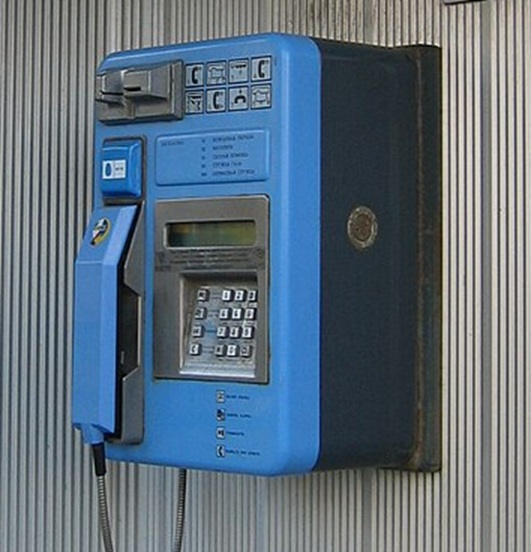
| Name | Siemens-Infopyme TMI/TPM payphone |
| Date | 1990s and early 2000s. |
| Manufacturer | manufactured in Spain by Infopyme Comunicaciones |
| Link | Additional information at Moscow based payphone museum website- https://amt69.ru/ |


Above- images of the TMI-PC/S payphone. Note that the example on the left is in the usual stainless steel finish. The other units have been powdercoated red for the Russian market.
Siemens-Infopyme TMI/TPM payphone in Russia
The distinctive blue MGTS payphone seen around Moscow during the late 1990s and 2000s appears to belong to the wider TM-01 / Teléfonos Modulares family developed by the Spanish company Infopyme Comunicaciones, rather than being an exclusively Russian Siemens design. The modular platform was widely exported and Infopyme is recorded as supplying equipment to Russia as well as Spain, Latin America, Turkey, South Africa, Australia and other markets.
The TM (Teléfonos Modulares) concept was deliberately adaptable. Separate modules could accommodate a coin validator, card reader, LCD display, keypad, communications electronics, cash box and handset. This allowed essentially the same rugged terminal to be configured for different currencies, telephone networks and payment systems. Versions ranged from coin-only machines to combined coin/card models and later card-based and prepaid-mobile-recharge terminals.
In Moscow the terminal was associated with MGTS (Moscow City Telephone Network) and apparently incorporated Siemens electronics or technology, hence its identification by the AMT-69 Museum as a Siemens MGTS payphone. The museum records a clear evolution: the Moscow machines initially accepted coins, were subsequently converted to combined coin-and-chip-card operation, and finally became card-only telephones.
Its heavy vandal-resistant casing, stainless-steel components, small LCD, substantial keypad and reinforced handset made the design particularly suitable for exposed street installations. Examples were mounted in MGTS booths and near busy public locations such as Metro stations.
The Russian machine is therefore particularly interesting as an example of an international modular payphone platform adapted for Moscow, bridging the era between Soviet coin telephones and the smartcard-based public telephone networks of the early twenty-first century.
Name: Infopyme TMI/TPM electronic payphone
Variant: TMI-PCS / closely related TPM-PC/S Russian version
Manufacturer: Siemens-Infopyme
Country of manufacture: Spain
Russian deployment: late 1990s–2000s
Payment: electronic telephone/smartcard
Features: LCD display, keypad, ISO 7816 card processing, electronic tariff calculation
Typical installation: freestanding Russian metal Taksofon shelter
Above- the Amper in phone boxes
Russia’s Universal Communications Service programme
Russia’s Universal Communications Service programme (Универсальные услуги связи) still exists in 2026, and surprisingly, public payphones remain explicitly part of it.
Russia’s current Federal Law No. 126-FZ On Communications, updated through 2026, still contains an entire chapter governing Universal Communications Services. The statutory definition includes telephone services delivered through collective-access equipment, specifically mentioning таксофоны (payphones) alongside multifunction terminals and information kiosks.
Even more convincingly, Russia introduced new communications-licensing regulations effective 1 March 2026, and these still contain a separate category for “local telephone communication services using payphones.” Those regulations are scheduled to remain in force until 2032.
The programme has, however, evolved enormously from what your photographs show. Originally it was heavily associated with providing a basic telephone connection to small and remote settlements. Today universal service encompasses internet/data access and mobile communications access as well as public telephony.
So the Россвязь – Универсальные услуги связи lettering visible on your red Amper-Siemens payphone is significant. That machine wasn’t simply an ordinary commercial street phone: by that stage it was operating as part of Russia’s state-backed effort to guarantee basic communications access.
And there is an interesting historical twist for your payphone research: Russia has retained public payphones in its legal universal-service framework long after their practical importance collapsed. Current regulations even continue to specify tariff regulation for telephone calls made from payphones.
Leave a Reply