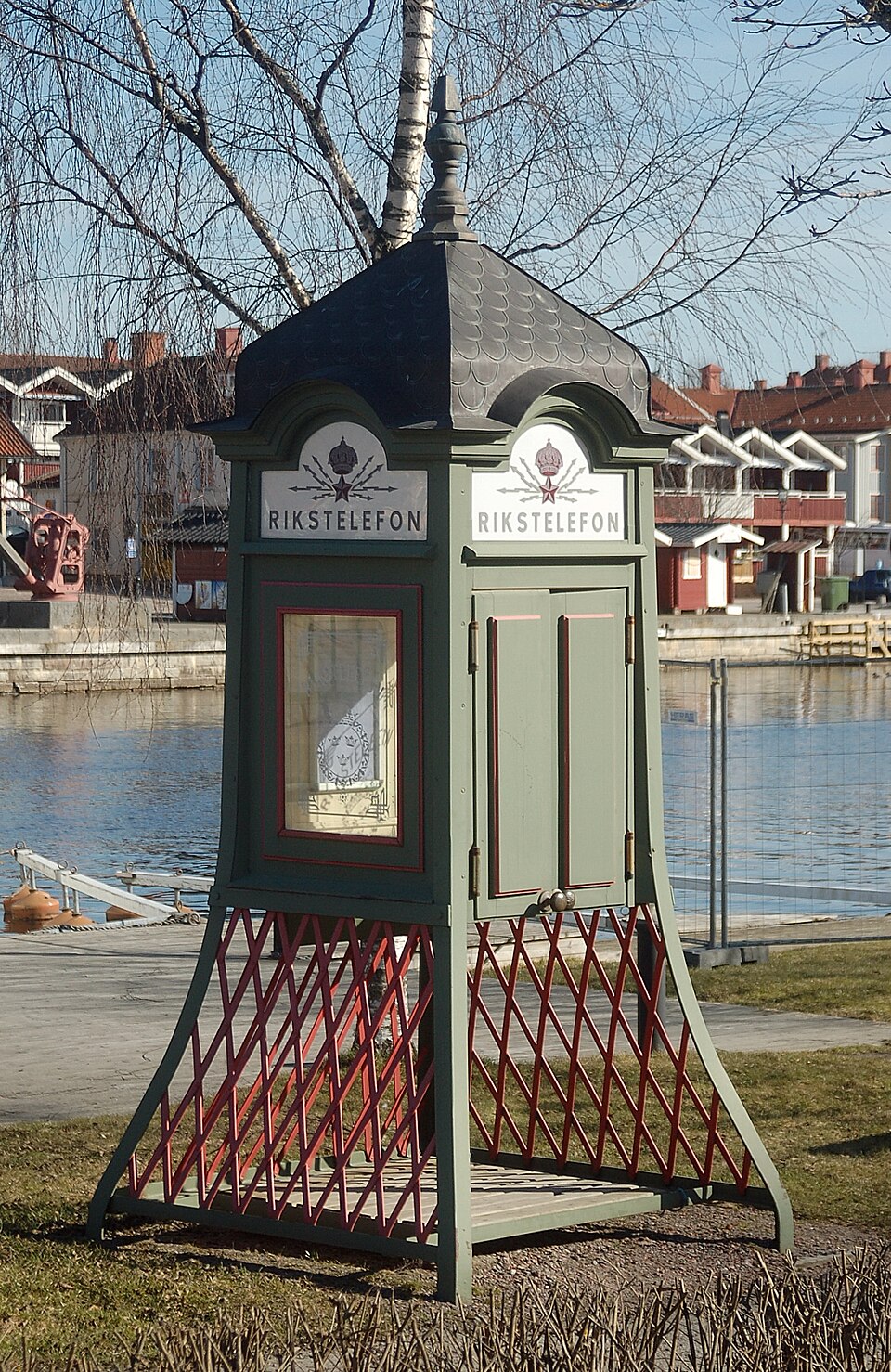
| Name | Pagoden phone booth |
| Date | c. 1901 Interesting how most Swedish phone booths are open for the lower portion (considering how cold it can be there). Good for ventilation and extends the life of the kiosk considerably. |
| Manufacturer | Telegrafverket’s Rikstelefon network. |
Swedish Phonebooth- 1900 Pagoden
The Pagoden was Sweden’s first standard public telephone kiosk and one of the country’s most distinctive pieces of street furniture. Designed in 1900 by Telegrafverket engineer Hjalmar Celion, it was patented on 11 October that year. The first example was installed in Stockholm’s Kungsträdgården on 4 April 1901, giving the public convenient access to Telegrafverket’s expanding Rikstelefon network.
Its popular name, meaning “the Pagoda”, came from its exotic roofline, projecting eaves and tall ornamental finial. The elegant kiosk combined decorative turn-of-the-century design with careful practical planning. Its iron frame supported glazed side panels with etched decoration, while open latticework around the base allowed people to see whether the kiosk was occupied and reportedly helped keep dogs away. Sound-dampening wall materials and an internal oak shelf reduced street noise, improving privacy and audibility during calls.
The Pagoden became a recognisable feature of Swedish towns, and a double version appeared in 1915, accommodating the competing Rikstelefon and Stockholmstelefon systems. Surviving examples are now valued historic objects rather than working kiosks. Several have been restored in Stockholm and elsewhere, while reproductions were manufactured during the 1980s after an original kiosk was dismantled and measured because the early drawings no longer survived for posterity. Sources: SVT and Kulturen Museum
Some Pagoden kiosks may be found in Finland because Swedish telecommunications equipment and architectural designs circulated widely there. Finland retained exceptionally close commercial, cultural and technical links with Sweden, particularly in Swedish-speaking coastal districts and Åland. Swedish companies—especially Ericsson—also supplied much of Finland’s early telephone equipment.


Leave a Reply