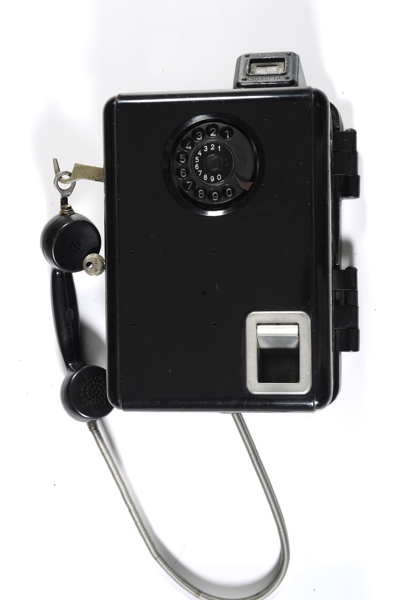
| Name | MFS 50- Siemens coin payphone 1960 |
| Date | Made in Germany in 1950 but used in Greece in the 1960s. |
| Manufacturer | It was manufactured by Siemens, probably in West Germany, and adapted for Greece’s OTE network. The Deutsche Bundespost was the German postal and telephone authority, not the manufacturer. |
| Links | Münzfernsprecher 50 used in Germany With thanks to- https://collections.otegroupmuseum.gr |


MFS 50- Siemens coin payphone 1960
This Siemens coin payphone, dating from about 1970, is a Greek OTE version of the German Münzfernsprecher 50 family. The original MF 50 was introduced around 1950 during West Germany’s post-war reconstruction, replacing the earlier Ortsmünzfernsprecher 28, 30 and 33. Robust electromechanical construction made it suitable for post offices, railway stations, public buildings and the familiar yellow street kiosks. It became an important part of the expanding Deutsche Bundespost payphone network throughout the 1950s and 1960s.
The Greek example retains the MF 50’s imposing black wall-mounted cabinet, rotary dial, coin slot, return chute, lock and Bakelite handset with armoured metal cord. Adapted for OTE, it accepted one-drachma and fifty-lepta coins. Its improved mechanism could recognise coins of different values, calculate charges according to call duration and return unused money. Importantly, callers could dial before depositing payment, so coins were not taken when a call went unanswered. Incoming calls could also be received without inserting money.
The telephone demonstrates how proven West German public-telephone technology was exported and adapted for another national network. Although technologically rooted in the 1950s, this OTE example apparently remained relevant around 1970, before electronic and card-operated payphones eventually displaced such heavy mechanical instruments across the country.
Leave a Reply