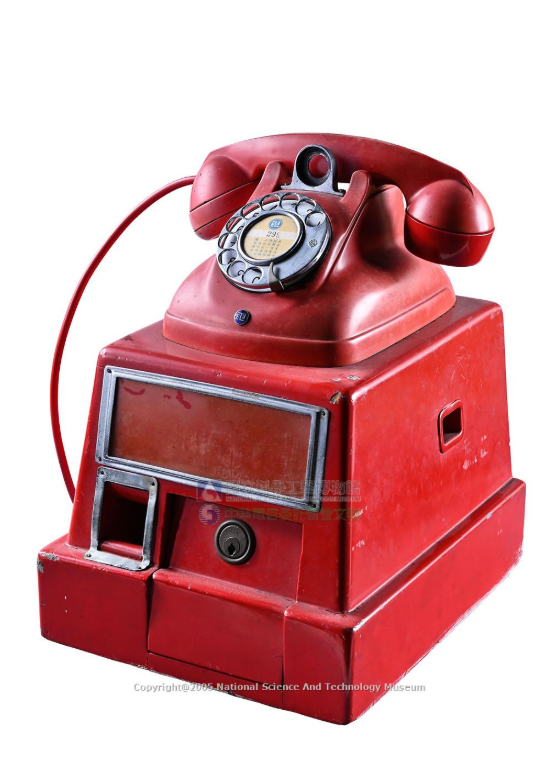
| Name | No. 4 post-paid public telephone |
| Date | C. 1960. Japan used ordinary No. 4 telephones as shop-counter public phones from 1951. NTT says these were initially conventional telephones; the shopkeeper collected charges. They were painted red from 1953 and became the ancestors of the Japanese red phone. |
| Manufacturer | TELECOM REPAIRING SHOP, TAIWAN TELECOMMUNICATION ADMINISTRATION BUREAU |
| Credit | Special thanks to the Taiwan National Science and Technology Museum |

Development of the Taiwan No. 4 post-paid public telephone
Taiwan’s National Science and Technology Museum identifies it as the No. 4 post-paid public telephone, made in Taiwan by the Telecommunications Administration’s repair workshop. It says the workshop adapted a No. 4 automatic telephone by adding a coin slot and cash box. The museum dates its example to 1960. culture.teldap.tw
It was for local calls and accepted a 50-cent New Taiwan dollar coin. According to the detailed museum description, the caller dialled first and, once connected, inserted the coin to activate the conversation circuit. The museum’s shorter operating description says to insert the coin before dialling, so its account is internally inconsistent; the post-payment description seems more specific, but the exact sequence deserves checking against operating instructions. telecom.nstm.gov.tw
Background information
- Japan adopted the No. 4 automatic desktop telephone in 1950. Taiwan’s museum identifies a No. 4 automatic telephone as the basis of its conversion, but does not explicitly establish where that particular base telephone was made or whether the Taiwanese cash attachment copied a Japanese one. sts.kahaku.go.jp
- Japan used ordinary No. 4 telephones as shop-counter public phones from 1951. NTT says these were initially conventional telephones; the shopkeeper collected charges. They were painted red from 1953 and became the ancestors of the Japanese red phone. NTT東日本
- Japan also introduced a No. 4 automatic box public telephone accepting 10-yen coins in 1953. It used a post-payment arrangement, although NTT describes a push-button and timed sequence that should not automatically be assumed to be identical to the Taiwanese mechanism. NTT東日本
The best Japanese example I found is on NTT East’s illustrated history: scroll to 4号自動式ボックス公衆電話機 for the 1953 coin-operated model. The same page shows the 4号自動式委託公衆電話機, the shop-counter version. NTT’s technical museum display also illustrates the shop-counter No. 4 and its successor.
I cannot yet confirm is that its particular coin box was copied directly from a specific Japanese model. The Taiwanese museum’s catalogue entry describes the conversion as a local development.

Leave a Reply