| Name | Misc Card Phones |
| Date | c. 2000 Post late 90s there were a large number of domestically produced card phones for the local market. |
| Manufacturer | Various, including Function International |


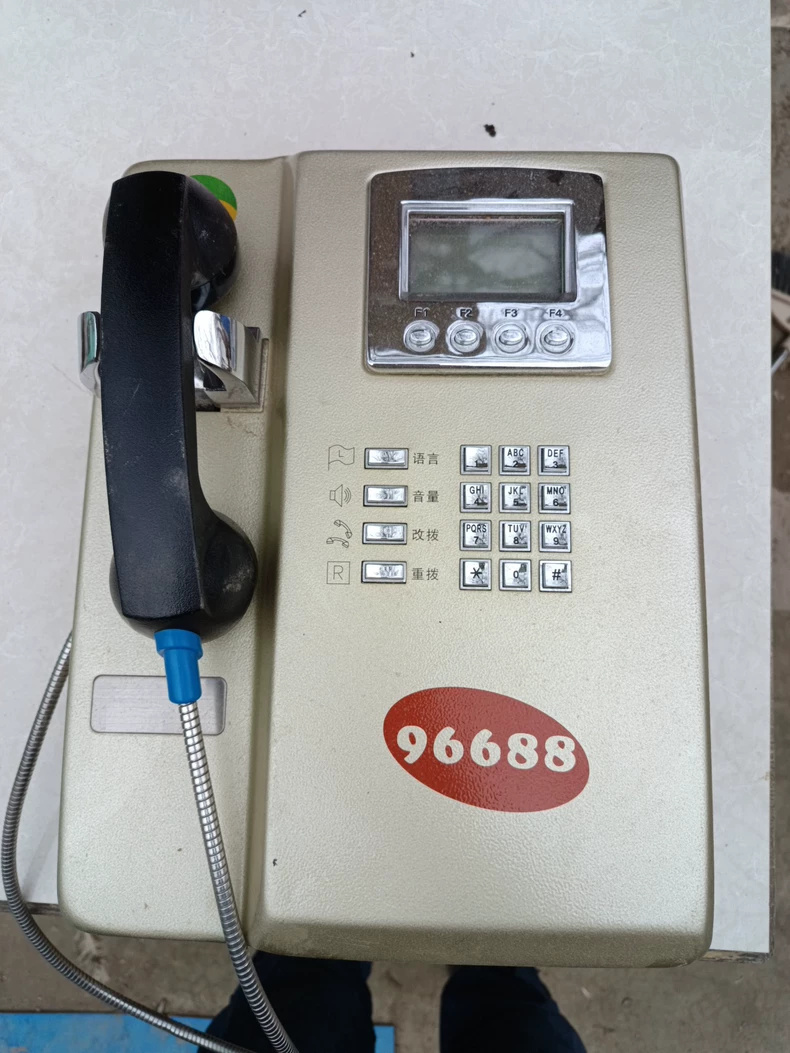
Above- The F-820(B) was a Chinese wall-mounted public telephone with a metal keypad, a display and dedicated buttons for language selection, volume and redial. The beige example carries Gansu Rural Credit branding and the number 96688. A similar China Netcom phone photographed in Beijing in 2012 has an IC card slot.
Function Group, known in China as Baofeng (宝丰), made the F‑820 family. The lower-left badge on the Beijing phone reads 宝丰通信 (Baofeng Communications), while CNC 中国网通 identifies the operator, China Netcom. A payphone parts supplier independently lists the F‑820 under Function. 3166-th.all.biz
The beige Gansu Rural Credit example is labelled F‑820(B). The Beijing phone has the same display and keypad layout but adds a front IC-card slot. Its exact model suffix is unclear. A 2008 trade profile reports that Baofeng’s public phones were distributed across China by 1996, supported by more than 130 service outlets. That figure covers the company’s wider range.


Above- This wall-mounted public telephone was made by Shenzhen Guanri Telecom-Tech for China Telecom’s 200 calling card service. The faceplate carries Guanri’s green logo above a bilingual keypad with buttons for adding credit, changing cards and making successive calls. The notice above the slot says ordinary IC cards cannot be inserted.
China Telecom’s 200 service was a calling-card system for domestic and international long-distance calls. On an ordinary touch-tone phone in a participating city, you dialled 200, entered your card’s account number and PIN, then dialled your destination. The charge came out of your prepaid balance, so several people could use the same phone and pay for their own calls. cn.govopendata.com
Where it was used. By 1997, People’s Daily reported that 22 cities were linked, including Beijing, Shanghai and Guangzhou. In Guangzhou, dedicated indoor 200 phones spread through university dormitories and factories from the late 1990s. A 2008 report identifies one specific site, the Shipai campus of South China Normal University. Dalian also had campus installations by 2000. The sources document the service and these installations, but the location of your exact Guanri unit remains unverified. cn.govopendata.com
What the slot tells us. Your Guanri is marked 200专用话机, meaning “dedicated 200 telephone.” The notice above the slot says ordinary IC cards could not be inserted for use. In 2003, Guangdong Telecom introduced a rechargeable 200 IC card designed to reduce theft of account numbers and PINs. That gives us a plausible explanation for the slot, although the exact card format this Guanri accepted is still unverified.


Above- The first is a Shensi cardphone with a physical card slot. The second is a Dongying calling-card terminal where callers keyed in their account details.
| Phone | What the markings tell us |
|---|---|
| Yellow handset and wedge-shaped base | The 神思 badge under the display identifies Shensi of Jinan, Shandong. The same design appears with China Netcom (CNC) and China Telecom branding. One example has China Telecom printed on the case and a CNC sticker on the handset, suggesting it may have been relabelled in service. It has a front card slot and dedicated Chinese/English, function, hang-up and redial keys. Shensi’s corporate filings document several public-phone models. pdf.dfcfw.com |
| Black handset and tall silver keypad panel | The inscription 东营市电信局 identifies the Dongying Municipal Telecommunications Bureau, Shandong. The printed instructions say to dial 209, 201 or 300, then enter the card number, PIN and destination, confirming each with #. That’s the same basic dial-in method as the 200 service above. Shandong’s telecom history identifies 201 as its provincial calling-card service and 300 as the nationally networked service. The faceplate confirms 209 was supported. |


Above- Network: China Telecom (中国电信). The faded blue badge above the handset identifies the operator. The yellow faceplate identifies it as an IC-card public payphone, and the pictograms show callers inserting a card before dialling.


Above- These white China Telecom payphones accepted prepaid contact chip cards. The manufacturer remains unconfirmed. Issued in August 2001, the two cards shown commemorate China’s Ninth National Games in Guangdong and feature Weiwei, the lion mascot. Priced at ¥29 and ¥48, they included ¥1 and ¥2 in bonus call credit respectively.
Development of the Chinese cardphone landscape
In the early 2000s, China opened its public telephone market to competition while retaining licensing for operators and network approval for equipment. The 2002 restructuring transferred the former China Telecom’s local networks in ten northern provincial-level regions to China Netcom (CNC). The reconstituted China Telecom retained the other 21. China Railcom (Tietong) also entered the public telephone market, while China Mobile and China Unicom gained permission to offer wireless public telephones. In Nanjing, all five competed through staffed telephone shops known as huàbā.
By 2002, Wuhan Jinglun (Routon) reported that about 23 manufacturers held approval for IC-card payphones, and around 15 could produce them at scale. Suppliers included Chengdu Guoteng and Guangzhou Post and Telecommunications Equipment, alongside locally based ventures such as Shanghai Alcatel and Changsha Schlumberger. Routon alone reported selling 86,000 IC-card phones in 2001.
Callers could insert a prepaid chip card at a street payphone or use a service such as 200 by dialling an access number and entering an account number and PIN. Dedicated 200 terminals reached university dormitories and factories, where callers sharing a telephone could pay for their own calls. China Netcom merged with China Unicom in 2008, ending CNC’s run as a separate operator.


Leave a Reply