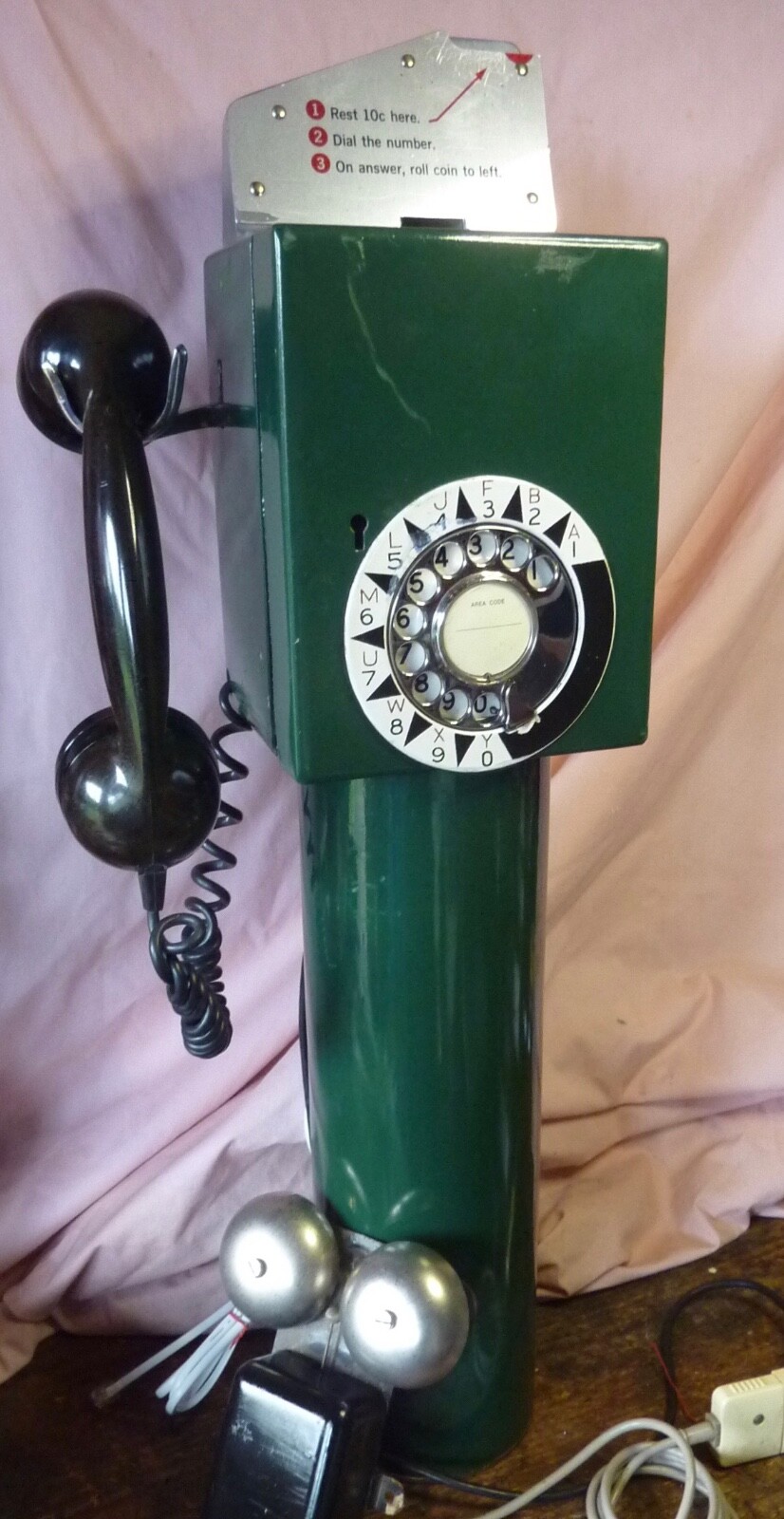
| Name | Variable Tarif Long Barrell Green |
| Date | 1930-1970 |
| Manufacturer | PMG Sydney Workshop |
| Usage | Boothes |
| Notes | Known as the Long Tom |
| PTVT-04 | See more notes below. |


Development of the Long Tom
| 1955 VARIABLE TARIFF LOCAL CALL INSTRUMENT: In 1955 a new mechanism was introduced and fitted to all existing Automatic Fixed Unit Fee instruments. The mechanism was designed so that it all attached to a backing plate which could be completely removed for maintenance, unlike the earlier two penny type which had parts strapped to various areas of the interior. The new redesigned coin head had provision for up to four pennies to allow for tariff changes (Fig.14). The coin head was slotted to hold two, three or four pennies and a button at the end of this slot, when pressed, allowed the coins to run down in sequence. HOW THE VARIABLE TARIFF MECHANISM WORKED: The coins passed straight through the coinway into the tin, but in so doing each successive coin triggered a pawl which acted on a toothed escapement. As each coin passed the pawl, the escapement dropped one tooth. The correct number of coins caused the escapement to operate springs which changed the circuitry to allow conversation to proceed. In the fixed transmitter type, the escapement was reset in readiness for the next call, by a lever on the switchhook which operated when the receiver was hung up. the pay station type, the escapement was reset by a magnet in the ‘mechanism, which operated when the handset was replaced on the table telephone. 1964 AUTOMATIC FIXED UNIT FEE INSTRUMENT REVISION: The existing Variable Tariff instruments were modified again in 1964 to a1low for a six penny local call rate. A new coin head of the fixed insert type was provided and the penny chute was replaced by a narrower chute track, and the number of teeth on the escapement reduced to one. LOCAL CALL BARREL MAGNETO VERSION (Fig 19): As the unit fee tariff increased in country manual areas the fixed transmitter type barrel changed in the same ways described for auto areas; the change of coin head and mechanism was the same. Basically the barrel type had a magneto where the dial is situated on conventional instruments. Even CT1 instruments were designed at a much later date for manual areas. 1966 LOCAL CALL BARREL REVISION (Fig 24): Decimalisation in 1966 meant that the existing coin head had to be changed to five cents. Both five cents and six pence are the same size so there was no change to the mechanism, but because both currencies were circulating a redesigned coin head was provided. A five cents or six pence coin head of the roll coin design was provided on all existing barrel instruments (later updated to 10c operation in the early 70s). Source- (with thanks to) History of the telephone in New South Wales / by Jim Bateman [Croydon, N.S.W.] : J. Bateman, 1980 ISBN: 0959478701 Below- British racing car driver Stirling Moss uses a public phone on arrival at Mascot (SLNSW)  |


Above- original 1955 version, with 4 penny coin head.
The Australian Variable Tariff “Long Tom” Public Telephone
Introduced in 1955, the Variable Tariff Automatic Public Telephone represented a major advancement in Australia’s public telephone network. Commonly known as the “Long Tom”, this new generation of payphone replaced earlier fixed-tariff models and allowed the Postmaster-General’s Department (PMG) to adjust call charges without replacing the entire instrument.
The Long Tom was produced in two configurations: a fixed-transmitter wall-mounted model, where the user spoke into a permanently attached transmitter and listened through a separate receiver, and a handset wall-mounted model incorporating a conventional telephone handset. Although differing in appearance, both versions used the same internal coin and switching mechanisms.
Earlier Australian payphones operated on a fixed charge of two pennies and offered little flexibility when tariffs changed. The Variable Tariff telephone solved this problem through a simple mechanical adjustment. By relocating a screw within the mechanism, technicians could set the required fee at two, three, or four pennies. This allowed the PMG to respond to changing costs without redesigning the entire telephone.
Like its predecessors, the Long Tom was a post-payment telephone. The caller first dialled and established a connection. Incoming speech from the called party could be heard immediately, but the caller’s transmitter remained disabled until payment was made. Once the called party answered, the user pressed a button, allowing the required coins to enter the mechanism.
The coin slot was designed to hold up to four pennies standing on edge. When the payment button was pressed, the coins rolled down an inclined chute, activating an escapement mechanism. Each coin advanced a toothed rack by one step. Depending on the tariff setting, the rack required two, three, or four steps before reaching its fully lowered position. Only then were electrical restrictions removed, enabling normal two-way conversation.
A notable feature of the Long Tom was its reliance on line polarity reversal. When the called party answered, the telephone exchange reversed the voltage on the speech wires. This reversal, combined with a series of metal rectifiers, ensured that outgoing speech remained blocked until the correct payment had been deposited. Once the rack reached its required position, these rectifiers were bypassed and conversation could proceed normally.
The system worked effectively for ordinary local calls but had limitations. Calls to free services such as emergency numbers did not generate line reversal, allowing users to speak without depositing coins. Conversely, if maintenance work accidentally reversed the line polarity, the telephone would become unusable until corrected.
Most Long Tom telephones were not fitted with bells because incoming calls to public telephones were uncommon. However, units leased to clubs, shops, and other private premises could be equipped with bell sets to permit incoming calls. The telephones also incorporated coin-box alarm springs that short-circuited the line if the cash box was removed, although these devices often proved troublesome and were frequently disabled by maintenance staff.
The designation “unit fee” indicated that these telephones were intended only for local calls charged at a single unit rate. Long-distance and operator-assisted trunk calls could not be made from them.
During the early 1960s, the Long Tom was modified to accept sixpence, later equivalent to 5 cents after decimalisation, and eventually 10-cent coins. These changes required new coin heads, chutes, and extensive alterations to the internal mechanism. Increasing vandalism during the 1960s and 1970s led PMG workshops to develop reinforced versions, typically finished in a distinctive hammertone grey paint. Despite these improvements, the Long Tom gradually disappeared as more sophisticated multi-coin payphones were introduced. By the early 1980s, this once-familiar Australian payphone had vanished from public streets, marking the end of an important chapter in the nation’s telecommunications history.


Leave a Reply