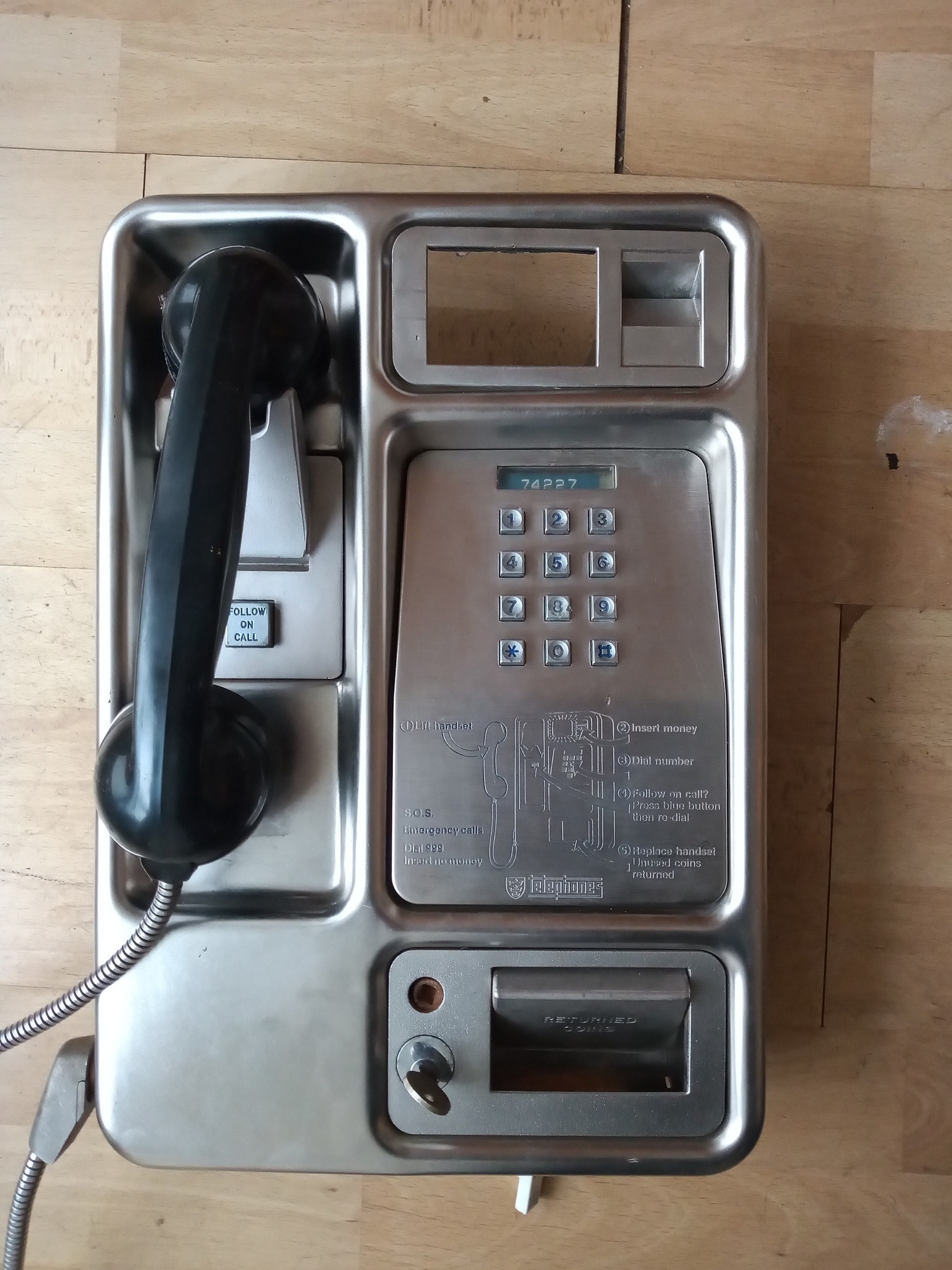
| Name | Payphone 600- Blue Payphone 2 |
| Date | 1983 – present |
| Manufacturer | GPT (GEC-Plessey Telecommunications). UK |
| Link | Payphone 600 used in New Zealand Payphone 600 used in Mexico Swedish Telia GPT-Plessey |


Development of the Payphone 600- Blue Payphone 2
| CT24- Payphone 600 – Blue Payphone 2 The Payphone 600, officially designated as CT No. 24A (Type: CT24), was introduced by British Telecom in 1983 as a robust, self-contained, microprocessor-controlled payphone. Manufactured by GPT (GEC-Plessey Telecommunications). UK, it was developed to replace earlier mechanical coin-operated models, bringing in more advanced technology suitable for high-use public locations. It accepted a range of coins—2p, 5p, 10p, 20p, 50p, and £1—with capacity for up to 15 coins to be inserted in advance, and a total cashbox capacity of around £150. The unit featured a digital display showing the minimum charge, remaining credit, and refund due, with unused coins returned automatically when the handset was replaced. Constructed from stainless or mild steel with a large lockable cash compartment, it required a Subscriber Meter Pulsing (SMP) service and a reliable earth connection. Programming and tariff adjustments were carried out using a handheld Tester 297A. It supported local, national, international, emergency, and operator-assisted calls. The Payphone 600 remained widely used throughout the 1980s and 1990s, particularly in unsupervised public environments. BLUE PAYPHONE 2 This payphone incorporates all the features of Blue Payphone 1, such as:- Easy local STD and international dialing. Pressure-free coin slot with no interruptions to speech if coins are inserted during a call. Follow on calls with remaining credit. Up to fifteen-coin insertion advance. Full visual display of minimum fee and Credit Remaining. “Cash Box Full’ sensor to help prevent coin jamming. Full operator service, including free 999 calls. Identification tone on incoming and operator connected calls. It will also take most denominations of coins: 2p, 5p, l0p, 20p, 50p and £1 coins. |
The CT54 Payphone
The CT54 was the successor to the CT24A (BT Payphone 600), introducing a range of improvements while retaining the same robust wall-mounted design. Externally, the easiest way to distinguish the two models is by the handset: the CT54 features a modern square-profile handset, whereas the earlier CT24A uses a rounded handset. The CT54 also incorporates a larger dot-matrix LCD display, replacing the fixed-segment screen of its predecessor. When idle, the display cycles messages such as “BT PAYPHONES” and “TO CALL LIFT HANDSET”.
Internally, the CT54 represented a major technological advance. Unlike the CT24A, which relied on meter pulses supplied by the local telephone exchange to calculate call charges, the CT54 stored tariff information within its own memory. This allowed it to operate independently of the Meter Pulse Facility, which was progressively withdrawn from the BT network between 2007 and 2008.
The electronics were also completely redesigned. The large through-hole circuit board and plug-in nickel-cadmium backup battery of the CT24A were replaced by compact surface-mount electronics spread across two modular printed circuit boards. A small soldered supercapacitor replaced the rechargeable battery, reducing maintenance requirements while improving long-term reliability. These advances made the CT54 smaller, more efficient and easier to service than its predecessor.
With thanks to https://www.ct54.info/home
Below- CT54 images


Leave a Reply