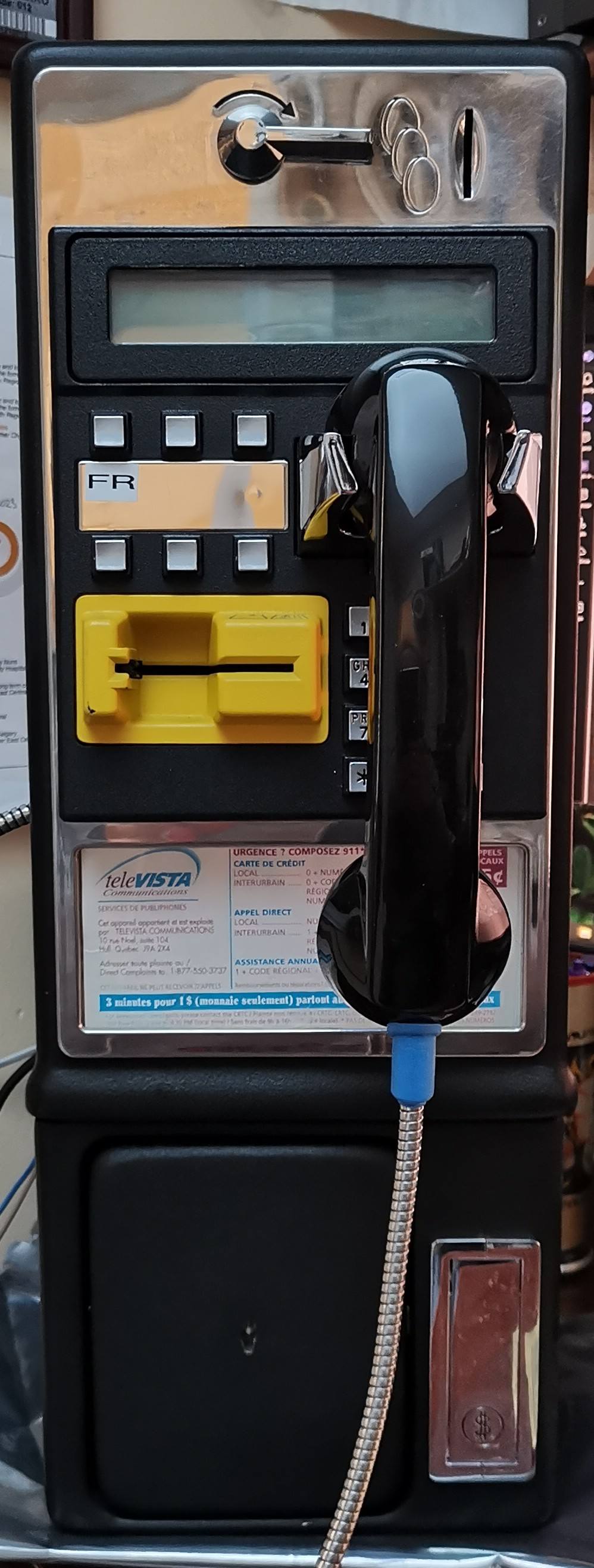
| Name | PROTEL 7800 Payphone. This unit was not as common. Widely exported to South America, Australia, etc. |
| Date | Late 90s |
| Manufacturer | Protel Florida |


Development of the PROTEL 7800 Payphone
| General Description The Protel 7800 appears to be one of Protel’s smart payphone models that incorporated electronic control boards with LCD or VFD displays — more advanced than the basic 7000 series — suggesting deployment in the late 1990s to early 2000s, during the era when Protel’s line-powered smart payphones were widely sold. It used an internal controller (e.g., an MC68HC705 microcontroller) and had provisions for messaging on a display, indicating it was a more feature-rich unit than the standard 7000/7000c boards. Deployment & Usage The 7800 was used in customer-owned coin-operated telephone (COCOT) environments rather than traditional telephone company coin line service — similar to other Protel products of the era. Collector sightings show examples existing in North America, including units with LCD display assemblies, which were comparatively uncommon relative to simpler 7000-based sets. The presence of an LCD and more sophisticated board implies it may have been targeted at competitive payphone operators and specialized locations (e.g., high-traffic venues, hotel lobbies, or international markets where enhanced displays/messages were desirable), though specific operator lists are not documented online. Key Characteristics It has an internal controller (MC68HC705) for managing display and calling logic. It shared lineage with Protel’s electronic smart payphones and likely used similar ExpressNet programming tools. Summary: The Protel 7800 was a later-generation electronic payphone model with display capability, deployed mostly in North America by independent operators during the late 1990s and early 2000s as part of Protel’s smart payphone lineup. Documentation is scarce, but it stands as a relatively rare variant compared with the more common Protel 7000/7000c units. Below- Protel 7800 in use in Australia, 2024 (Sydney University, now removed).  |
Leave a Reply