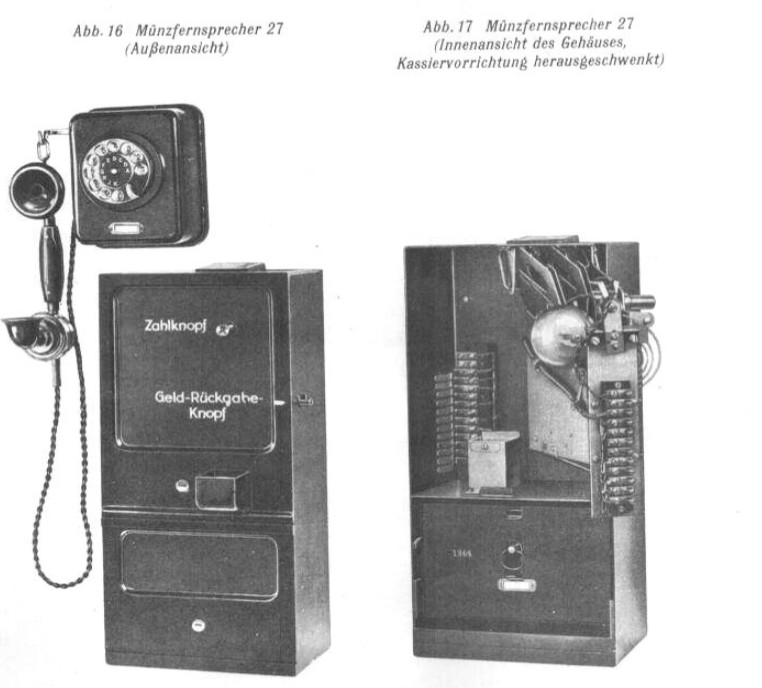
| Name | Münzfernsprecher 27 |
| Date | 1927 |
| Manufacturer | Deutsche Reichspost. Manufacturer not identified in Reichspost technical documentation; attributed in secondary sources to Standard Elektrik Lorenz. Mechanism likely based on the British A.B. Button Box Multicoin by Automatic Telephone Manufacturing Co. Ltd. (ATM) |
| Link- | Technical Manual (PDF in German) |


Development of the Münzfernsprecher 27
| The Münzfernsprecher 27 (M27) was one of Germany’s most advanced pre-war coin-operated telephones, developed by the Deutsche Reichspost during the late 1920s and introduced into widespread service in the early 1930s. Designed as a robust wall-mounted unit, it combined a standard dial telephone with an intricate, integrated coin control system housed within a secure metal cabinet. The M27 represents an outstanding example of the sophisticated mechanical engineering that characterised public telephone technology before the advent of electronic control systems. At the heart of the M27 was a highly engineered Kassiervorrichtung (coin control mechanism). The telephone accepted 5 Pfennig, 10 Pfennig, 50 Pfennig and 1 Reichsmark coins, each entering dedicated insertion slots before passing through a series of authentication tests. Permanent magnets and a weight-sensitive Münzwaage (coin scale) verified the authenticity and denomination of each coin, while guided channels directed valid and invalid coins along separate paths. Accepted coins were temporarily retained by the mechanism until the call was authorised, while rejected coins were automatically returned to the user. A secure, removable Geldbehälter (cash box) stored collected coins and could be locked and sealed for servicing. The M27 employed a sophisticated combination of levers, springs, pivots and electrical contacts to control both the mechanical movement of coins and the operation of the telephone circuit. Electrical relays and switching contacts worked in conjunction with the mechanical components to enable the speech circuit, register payment, collect local call charges and return coins when required. A modified rotary dial incorporated additional contacts linking the act of dialling with the payment system, ensuring that calls could only proceed once the correct fee had been deposited. Distinct payment and refund buttons allowed the user either to commit the deposited coins to the cash box or recover them if the call was abandoned. The M27 bears a remarkable resemblance to the British AB Button Box, developed by Automatic Telephone Manufacturing (ATM) in 1925, suggesting either shared engineering concepts or direct technical influence between the British General Post Office and the Deutsche Reichspost. Both systems relied on mechanically operated payment and return buttons, complex coin validation mechanisms and integrated electrical contacts to manage call control. As such, the Münzfernsprecher 27 stands as an excellent example of the sophisticated hybrid of mechanical precision and early electrical engineering that defined the pinnacle of pre-digital public telephone technology. |
| More info- https://oeffentlichetelefone.de/ |

Leave a Reply