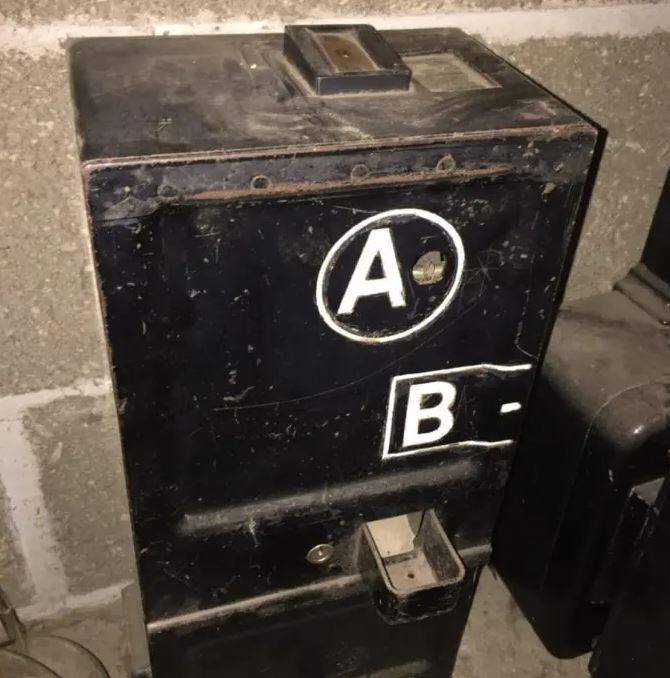
| Name | A/B box Multicoin Coin Collecting No. 14 |
| Date | 1925-1990 |
| Manufacturer | Automatic Telephone Manufacturing Co. Ltd. (ATM) |
| Usage | In phone booths |
| Links | AB MULTI COIN use in Australia AB MULTI COIN use in New Zealand AB Multi-coin as used in Ireland |


Above- Early A/B box- The imprint from the back of the board – FB27 = PO Factories Birmingham – i.e. constructed by PO Factories in their Birmingham factory in 1927
234 = GPO equivalent of ‘Mark 1’ – the first version of a Telephone
No 123 = Telephone No 123 – the early version of the A/B box coin telephone.
Image with special thanks to Ian Jolly

Above- the precursor, the BCC 13.
Use of the AB Button Box in the UK
| AB Button Box (stand alone unit) The British Post Office (BPO) AB Button Box, including later models such as the BCC14D, was one of the most recognisable public telephone coin systems in Britain throughout much of the twentieth century. Installed in thousands of red telephone kiosks and wall-mounted public telephones, these robust coin boxes reflected the British Post Office’s emphasis on durability, standardisation and mechanical reliability. Manufactured primarily by Automatic Telephone Manufacturing Co. Ltd. (ATM), the units were built to strict Post Office specifications to ensure identical operation across the national telephone network. The AB Button system was simple yet ingenious. Callers inserted the required coins and dialled the number. If the called party answered, pressing Button A transferred the coins into the locked cash vault and connected the call. If the call was unanswered or unsuccessful, pressing Button B returned the coins to the user. The mechanism operated entirely mechanically, using the size and weight of coins to test and route them through a complex series of levers, chutes and escarpments. Constructed from heavy cast iron or steel with precision-machined brass components, the boxes were designed to withstand vandalism, constant public use and the harsh conditions inside unheated outdoor kiosks. Manufacturing tolerances were tightly controlled, with every unit tested before installation. Most carried serial numbers, GPO markings and manufacturer insignia for maintenance purposes. Although internal mechanisms evolved over time, particularly around decimalisation in 1971, the familiar external appearance and operation remained largely unchanged. Today, the BCC14D and other AB Button Boxes are regarded as icons of British telecommunications history and remain highly prized by collectors and telephone historians. BPO A/B box Tariff BPO ones were originally 1penny/6penny piece/shilling from front to rear. Then when decimalisation came in February 1971, they became 2 pence piece at front and 10 pence(old pre-decimal 2 shilling piece) at the rear. Then at the very end of the A/B box in the early 1990’s a few were converted to 5 pence (Old one shilling) piece at the front and still with old 10pence(pre-decimal 2 shilling piece) at the rear. The GPO/PO didn’t bother purchasing any as they had sufficient old boxes for the few places that were still using A/B boxes until the early 1990’s – there was one that was in use until 1994 on the Island of Foula (Shetland Islands UK) – it is the only UK with the coin slots for 5p/10p rather than the usual UK decimalisation of 2p/10p. The inventor W. F. Hall was a British engineer active in the early 1920s, associated with the development of prepayment coin mechanisms for public telephones. His system required users to insert coins before a call, automatically enabling connection and disconnecting when credit expired. This innovation helped make unattended payphones practical and financially reliable. Hall’s ideas influenced early automatic telephone systems in Europe, particularly in France and Germany, where they were adapted by local engineers. By the late 1920s and 1930s, related coin-control devices were being commercially manufactured, likely through firms linked to his work, forming a key step in the evolution of modern payphones. Associated Automation name changes (from Grace’s Guide) 1921 Hall Telephone Accessories was formed as private company to make telephone coin boxes, automatic stamp and ticket selling machines. 1928 Became public company – Hall Telephone Accessories (1928). Frederick William Hall was technical adviser 1929 Acquired Thomas Watson and Sons, supplier to the Post Office and the Government 1938 New factory opened at Dowlais which would be used for Government work WWII Munitions work; towards the end of the war started making agricultural machinery in conjunction with Harrison, McGregor and Guest whose chairman had joined the board 1945 Name changed to H.T.A. Ltd 1947 AGM told that the GPO was still the most important customer, for whom the company was developing new lines; expected to establish a rentals business; still retained the shares in Harrison, McGregor and Guest Ltd to whom they had sold the Dowlais factory. 1948 Name changed to Hall Telephone Accessories 1949 Products included totalisator equipment 1955 Had developed bottle vending machines used by Coca-Cola and others; expansion by acquisition of adjacent factory 1955 Entered the field of automation, electronics and instrumentation by acquiring James Gordon and Co 1956 Name changed to Associated Automation with directors including Sir Robert Watson-Watt and Mr A. Sperry of Panellit Inc; Hall Telephone Accessories would continue as a subsidiary serving its existing customers 1956 Acquired Electroflo Meters Co 1957 Elliott Automation issued shares to the shareholders of Elliott Brothers and Associated Automation to effect a merger of the 2 companies, forming ‘the largest automation and instrumentation company in Europe’ Elliott Automation Group. 1961 Manufacturers of telephone coin-collecting machines, postage stamp machines and a patent type of self sealing cash box for the British Post Office, platform ticket issuing machines for British Railways, automatic bottle and commodity vending machines. Also manufactured office machinery, including duplicating machines, adding and listing machines. 850 employees. |
| Below- some interesting AB payphones used in Dublin, in the Republic of Ireland. These were in use in pubs, etc, up until the early 90s. |


Above- the last A/B box phone in use until August 1994 (collection of Ian Jolly) In use until 1994 on the Island of Foula (Shetland Islands UK) – it is the only UK with the coin slots for 5p/10p rather than the usual UK decimalisation of 2p/10p.


Above- the outside and inside of a GPO 200 type telephone fitted with a special coinbox dial – in this case a Telephone No 242 used on very early rural automatic exchanges (Unit Auto eXchanges No 5 & 6) which dialled ’01’ for the Operator . Note the different handset cord used on Kiosk telephones – a lot stronger than a plaited one and waterproof !And a few dial labels from Kiosks – the ’emergency’ information was on the notices on the backboard – hence kiosk phone dial labels only had the exchange name and number on them.
Images and info with special thanks to Ian Jolly


Above- shelf and backboard constructions drawings


Leave a Reply