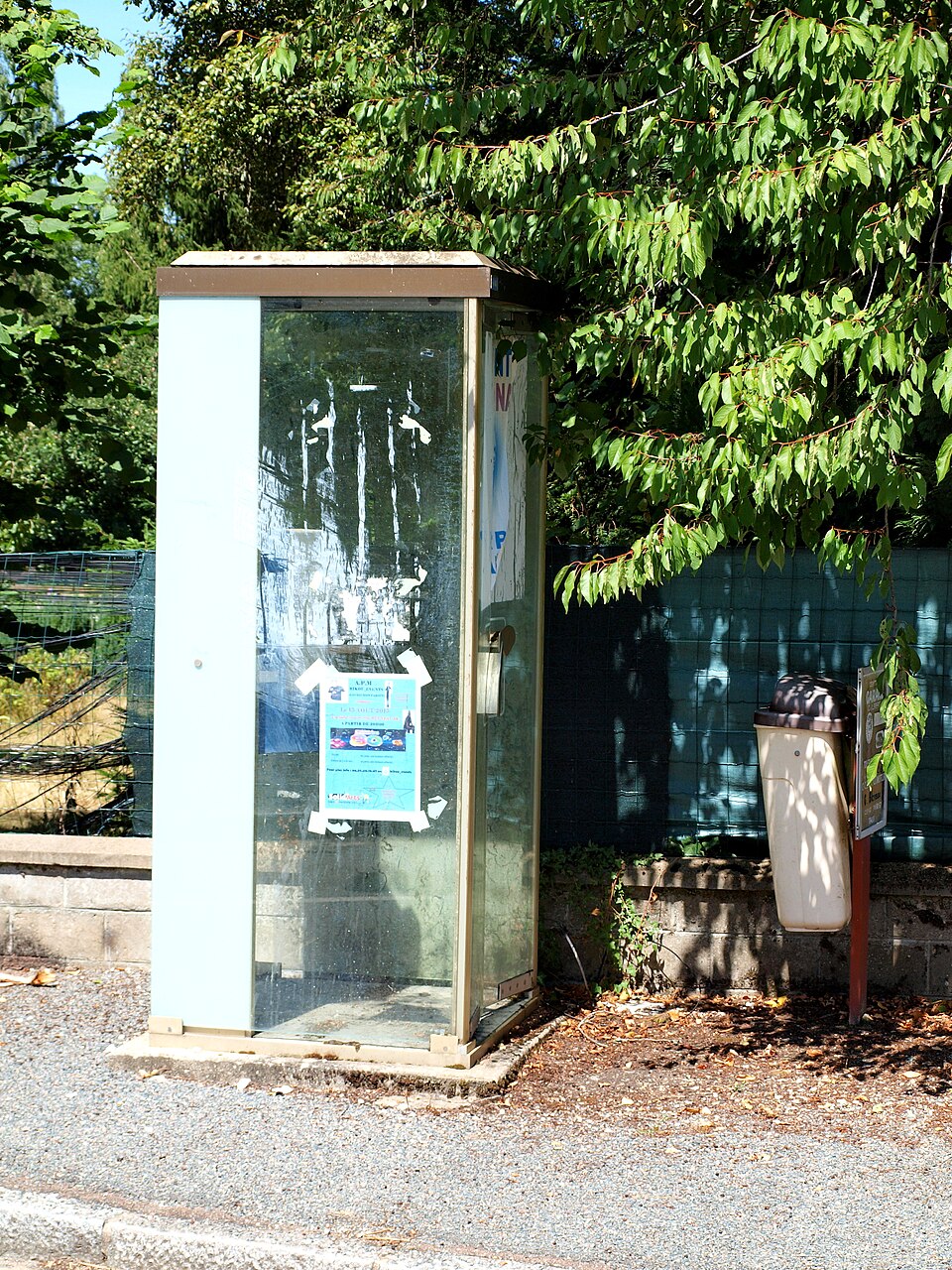
| Name | Booth C81 Cabine carrée en verre |
| Date | 1990 |
| Manufacturer | PTT / France Telecom |

Source- Orange-DANP collection. More information on the images- https://www.publiphonie.fr/page-562f584bb7200.html


Development of the cabine carrée en verre
| The Booth C81 represented a later and more simplified evolution of the highly regarded French public telephone kiosks developed for the France Télécom network during the late twentieth century. While retaining the strong emphasis on durability and visual quality characteristic of earlier French booth designs, the C81 adopted a more economical square-based form in place of the distinctive hexagonal geometry used on models such as the 601 and 601 SP. This simplified configuration reduced manufacturing complexity while still preserving the modern architectural character expected of French urban street furniture. Constructed using thick 8 mm Sécurit safety glass, the C81 maintained the transparent and visually lightweight appearance that had become central to French public telephone design philosophy. The extensive glazing improved visibility and user safety while also allowing the booth to integrate more subtly into streetscapes, railway stations, shopping centres, and civic plazas. Despite its elegant appearance, the structure was extremely robust. The single version weighed approximately 230 kilograms, while the larger double version reached around 430 kilograms, reflecting the substantial engineering and vandal-resistant construction standards required for heavily used public installations. The booth featured double-leaf doors that provided improved accessibility and easier circulation for users carrying bags or luggage. The symmetrical doors also reinforced the clean geometric appearance of the structure. France Télécom produced both single and double versions of the C81, including configurations with opposing doors or front-facing entries depending on site conditions and pedestrian movement requirements. These alternative layouts allowed the booth to adapt to a variety of urban environments and circulation patterns. Although less sculptural than the earlier hexagonal booths, the C81 remained distinctly French in its design language. Its restrained geometry, extensive use of glass, and careful detailing reflected the broader European modernist movement toward transparent and visually unobtrusive public infrastructure. The booth stood not merely as a protective enclosure for a telephone, but as a thoughtfully designed element of the public realm, balancing practicality, durability, and urban refinement. |
Leave a Reply