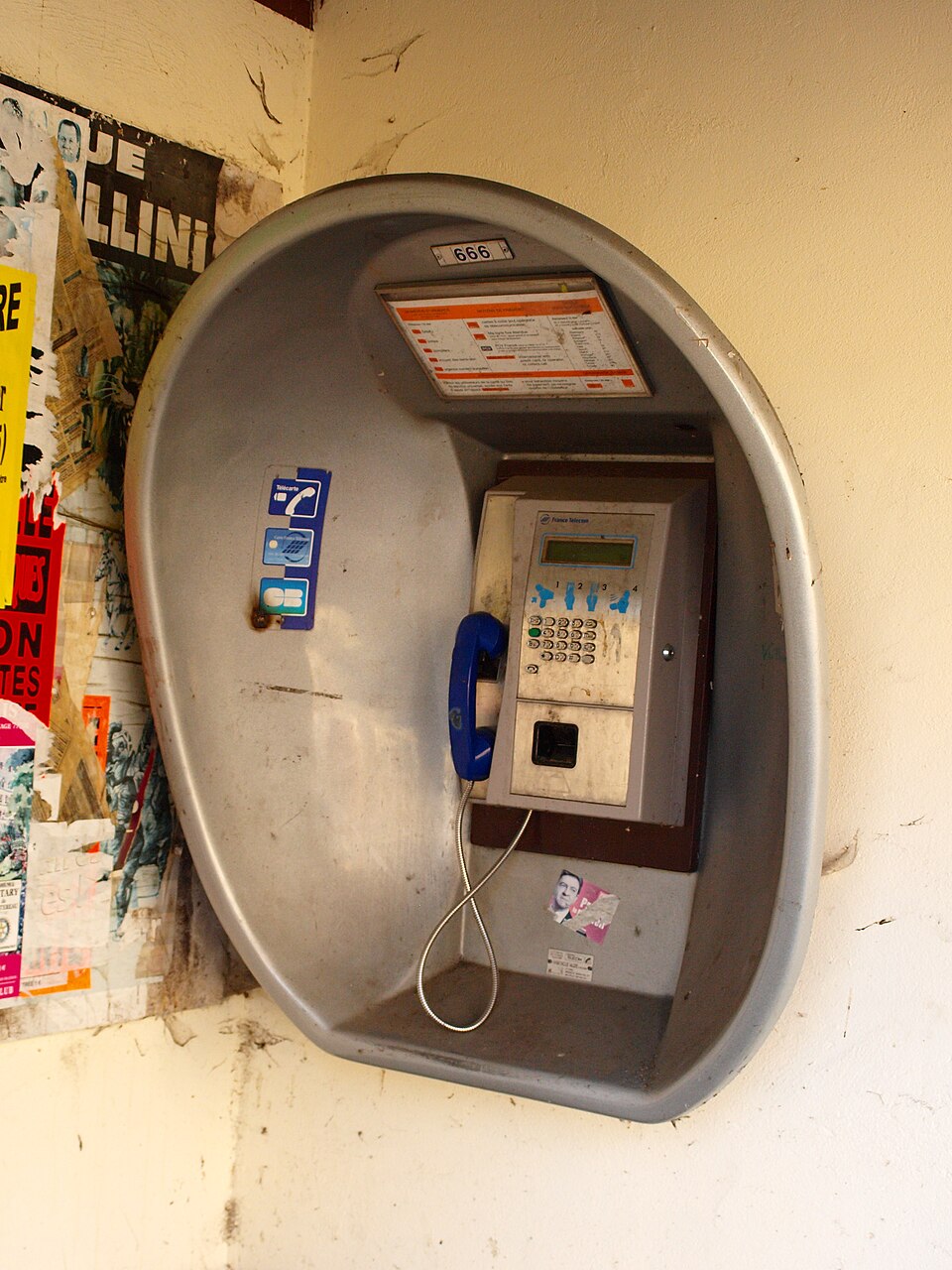
| Name | Cabine œuf mural |
| Date | |
| Manufacturer | PTT / France Telecom |


Development of the œuf mural
| These compact semi-enclosed units appeared mainly from the 1970s onward and were widely installed on building facades, railway stations, post offices, apartment blocks, transport interchanges, and narrow urban streets where a full booth was impractical. They were often oval or pod-shaped, giving rise to the “egg” nickname. Typically manufactured in moulded fibreglass, GRP, or heavy plastic composites, they projected from the wall like a capsule. Most incorporated: a curved acoustic shell, integrated lighting, a shelf or writing surface, and weather protection around the telephone unit. Their form was highly functional. The rounded enclosure improved: acoustic privacy, vandal resistance, weather shielding, and user visibility. Visually, they reflected the futuristic industrial design language common in France during the 1970s and 1980s, alongside projects such as the TGV, Minitel terminals, and modular urban furniture systems. Many were finished in strong colours — orange, cream, grey, or brown — before later France Télécom versions adopted more subdued tones. These kiosks were especially suited to dense historic urban environments because they occupied very little pavement space while still offering partial enclosure. In many locations they effectively replaced traditional booths entirely. |
Leave a Reply