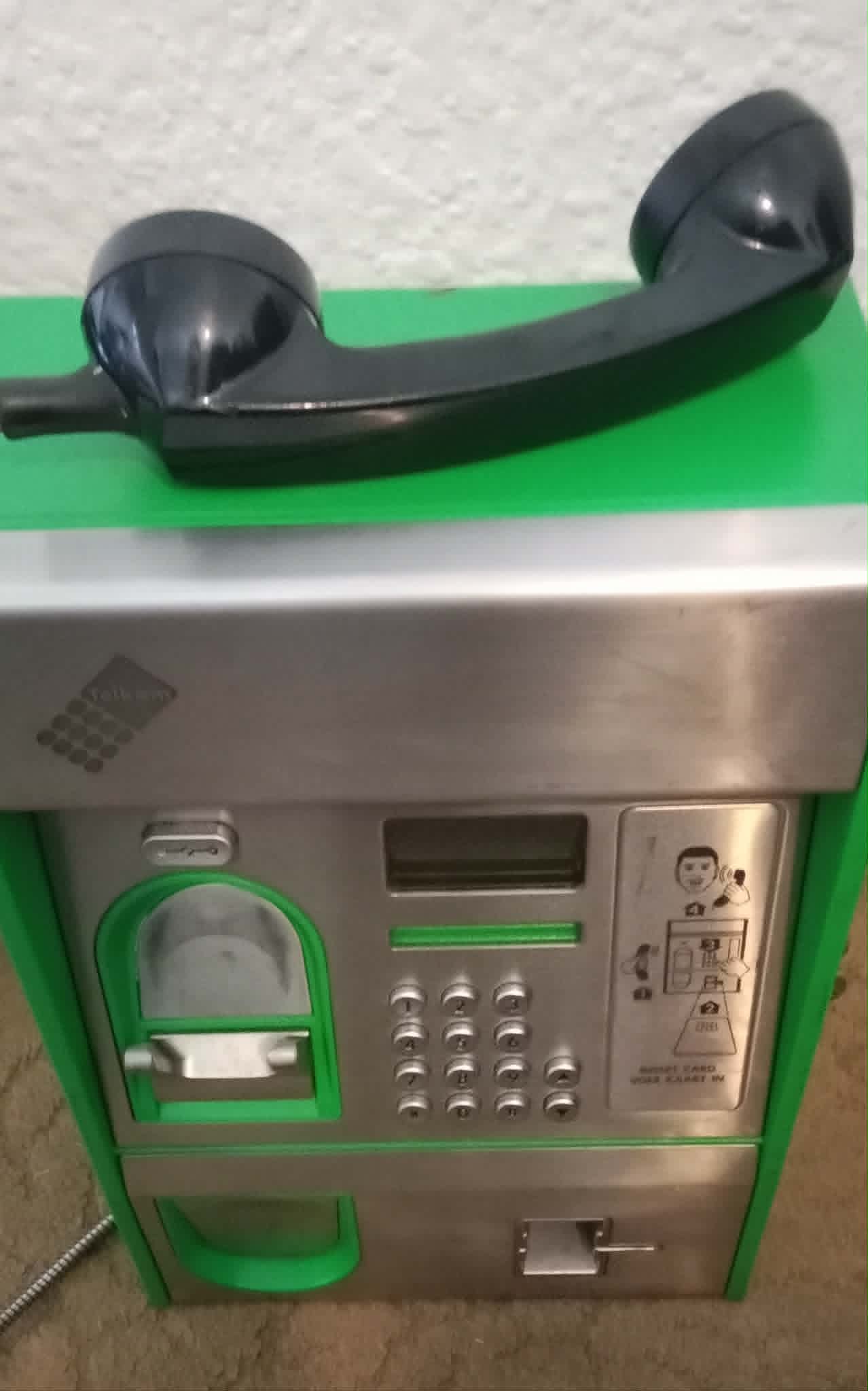
| Name | TELKOR ELECTRONIC PAYPHONES |
| Date | 1984–2000 |
| Manufacturer | Telkor (TMSA) at its factory in Springs, South Africa |

TELKOR ELECTRONIC PAYPHONES (1984–2000)
Manufactured by Telkor (TMSA) at its factory in Springs, South Africa, the TSA series represented the country’s final generation of public payphones and one of its most significant telecommunications achievements. During the apartheid era, international sanctions and trade restrictions limited access to overseas technology, requiring South African engineers to develop sophisticated electronic payphones largely through local research, design and manufacturing. Beginning with field trials in 1983–84, the TSA series introduced pre-payment operation, electronic coin validation, LCD displays and increasingly advanced keypads. During the 1990s, Telkor further developed magnetic and chip-card payphones featuring multilingual software, programmable tariffs and digital call control.
The robust modular design—characterised by a stainless-steel front panel, recessed handset and integrated electronic display—proved highly successful. Telkor technology and design concepts were subsequently exported or adapted for use in several European countries, including Romania, Greece, Albania and Bulgaria, where remarkably similar cardphones appeared during the 1990s and early 2000s. Whether supplied directly, manufactured under licence or developed from shared technology, these overseas models demonstrate the international influence of South African engineering. Today, Telkor’s electronic payphones are recognised as an important example of innovation emerging from a period of technological isolation.
Below- a selection of various Telkor models showing the design evolution. They all have similarhandset arrangments, etc.


Below- images of the prototype GPT payphone (with thanks to Peter Van Almelo)


Note- GPT was initially an amalgamation of Plessey and GEC, but later Siemens bought into the partnership when they purchased the customer systems part of Plessey. The initials CSL stand for Communications Systems Ltd, which is the successor company to GPT, but this name changed to Siemens Communications Ltd (SCL) when Siemens bought the customer communication businesses of GEC.
These amalgamations caused confusion, especially with the telephone models as some are produced by GPT but badged as GEC (these telephones are on the GEC telephone list – Models starting with T, i.e. T1039).
GPT Payphone Systems was a Marconi company. In its 18-year history, GPT Payphone Systems supplied nearly 1.5 million payphones to more than 80 countries. Marconi PLC is a global communications and IT company with around 49,000 employees world-wide and sales in over 100 countries. It supplies advanced communications solutions and the key technologies and services for the internet.
Below- these southern European payphones are very possibly made by GN payphone (Denmark). They look very similar to Telkor models.
Leave a Reply