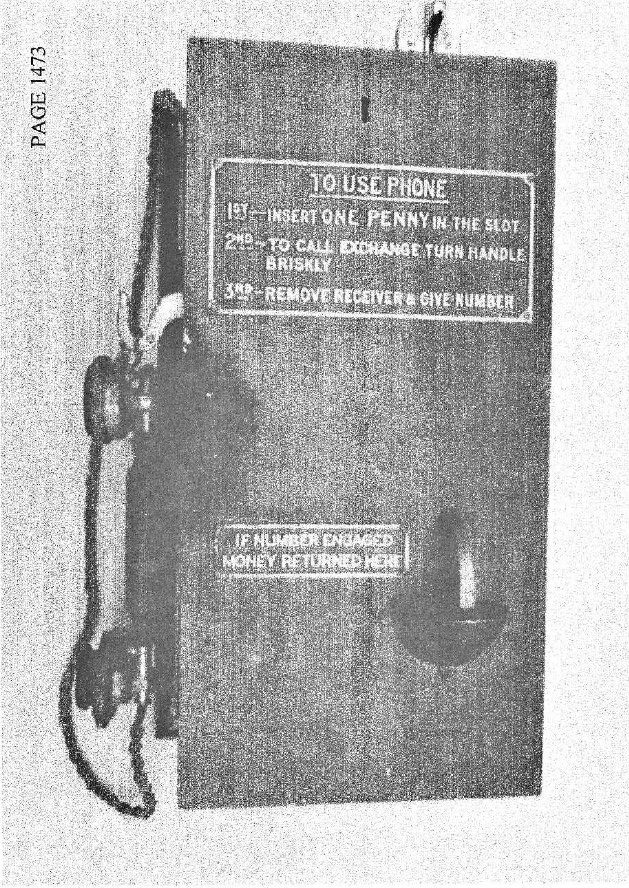
| Name | Early PUBLIC CALL OFFICE TELEPHONES |
| Date | 1910-1938 |
| Manufacturer | NZ PO |
| Link | NZ COIN BOX HISTORY (pdf file) Woodford 1938 paper |
Based on Woodford’s 1938 paper factual summaries of each telephone type.


Battery Call Reject Type (1910)
Introduced on 17 August 1910, this was New Zealand’s first public coin telephone, designed by F. Palmer. It operated as a prepayment instrument requiring a twopenny fee before the exchange could be called. The inserted coins were temporarily held within the mechanism until the call outcome was known. If the call succeeded, the coins were released into the cash box. If unsuccessful, the exchange operator energised a reject magnet, returning the coins to the caller. Following the reduction of the local call fee from twopence to one penny in 1914, the mechanism was modified by removing the original two-coin rocker arrangement.
Magneto Call Reject Type (pre-1914)
Developed before 1914 and also designed by F. Palmer, this prepayment telephone combined a magneto telephone with a hand-operated generator. The exchange could only be called after the required coin had been inserted. Turning the generator released locking pins that allowed the coin to complete the generator circuit. Once the call was completed, the mechanism either retained or returned the coin using the same reject mechanism employed in the battery call telephone. The design ensured that the exchange could not be signalled unless the correct fee had first been deposited.
Ericsson Coin-Collecting Box (c.1915)
Introduced around 1915, the Ericsson coin-collecting box was New Zealand’s first postpayment public telephone. It was used alongside a standard magneto telephone rather than incorporating the telephone and coin mechanism into one cabinet. After speaking with the exchange operator, the caller inserted the required penny and turned an external knob. This deposited the coin into the cash box while simultaneously operating a buzzer that notified the exchange operator payment had been made. The design suffered frequent burglaries, mechanical difficulties and poor reliability. It was gradually replaced by locally designed reed-type coin collectors.
Reed Type Coin Collector (c.1919)
Introduced around 1919, the reed-type coin collector replaced the Ericsson design as the standard instrument for magneto exchanges. It remained a postpayment system but eliminated the external operating knob. A correctly sized penny passed through a coin gauge before striking vibrating reed springs. These springs generated a buzzer signal that alerted the exchange operator payment had been made. The design also prevented withdrawal of inserted coins using string. Early models were vulnerable to fraudulent operation by striking the cabinet, but reinforcing the coin chute eliminated this weakness. Improved cabinets with sliding security doors later reduced theft and vandalism.


Penny Automatic Coin-in-Slot Telephone (1923)
Designed by F. Palmer and introduced in 1923, this was New Zealand’s first automatic public telephone. After dialling the required number, the caller inserted a penny once the called party answered. The falling coin activated the transmitter, disconnected fraud-prevention shunts, started a clockwork timing mechanism and enabled conversation. The original five-minute call period was reduced to three minutes in 1931. A warning buzzer sounded shortly before time expired, allowing another penny to be inserted. The design incorporated electrical and mechanical safeguards to prevent multiple calls being made using a single coin and formed the basis of New Zealand’s standard automatic payphone.

Threepenny Automatic Telephone (1928)
The first automatic threepenny public telephone was introduced in 1928 and designed by the Department’s own workshop staff. Because the threepenny coin was lighter than the penny, a small local battery was incorporated to assist operation of the coin mechanism. These instruments were installed throughout New Zealand but were later found unsuitable for conversion to timed operation. By 1935 the Department concluded that modifying the original mechanism was impractical and instead designed an entirely new replacement instrument incorporating a revised mechanism while retaining battery assistance for reliable operation.
Combined Magneto Coin-in-Slot Telephone (1938 prototype)
By 1938 the Department had developed a new combined magneto coin-in-slot telephone intended to replace earlier magneto installations. It housed both the telephone and the reed-type coin collector within a single cabinet using many standard components from the automatic public telephone. The design incorporated a British Post Office moulded handset, improved anti-side-tone induction coil, modern transmitter and receiver, and an improved steel case with enhanced burglary resistance. By reducing side tone by approximately 2–3 dB, speech quality was improved. Woodford identified this instrument as the future standard for magneto public call offices.
Leave a Reply