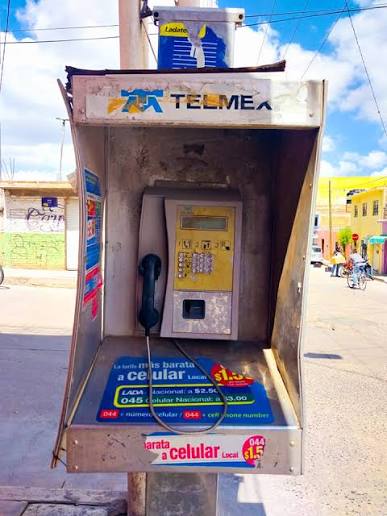
| Name | TELMEX SCHLUMBERGER CARDPHONE Access 110 |
| Date | Late 1990s |
| Manufacturer | Schlumberger, France |
| Links | Schlumberger Access 110 Cardphone used in Ireland Schlumberger Access 110 Cardphone used in France |
Below- the Schlumberger type


Below- the Schlumberger Access 110 Cardphone


Development of the TELMEX SCHLUMBERGER CARDPHONE
The Schlumberger Access 110 was one of the first generation of smart-card (chip card) public telephones introduced by Telmex in Mexico during the early 1990s. It marked a significant technological advance over traditional coin-operated payphones by using integrated circuit (IC) phonecards rather than cash. The terminal was manufactured by the French technology company Schlumberger, which was one of the world’s leading developers of smart-card technology and also supplied the microchips used in many telephone cards around the world. The same family of telephones was adopted by several major telecommunications operators, including France Télécom, Telecom Éireann (Ireland) and a number of Latin American and European networks.
Unlike earlier magnetic-stripe cardphones, the Access 110 used secure chip cards that stored the remaining call credit electronically on the card itself. Each time a call was made, the telephone communicated directly with the chip and deducted the appropriate number of units. This made fraud far more difficult and eliminated many of the reliability problems associated with magnetic cards.
The Access 110 was designed exclusively for prepaid phonecards and did not accept coins. Consequently, Telmex generally installed these telephones alongside conventional coin-operated payphones, allowing customers to choose either payment method. In busy locations such as bus terminals, shopping centres and city streets, it was common to find a pair of kiosks consisting of one coinphone and one cardphone. In smaller towns or lower-traffic locations, however, only a single cardphone or coinphone might be installed depending on local demand.
The examples shown in your photographs are installed in Telmex’s standard stainless-steel street kiosk. Above the canopy is the distinctive Ladatel sign, identifying the service as part of Telmex’s prepaid cardphone network. The advertising panels fitted to the kiosk were often updated to promote Telmex services such as Infinitum broadband or discounted calls to mobile phones, illustrating how the company used its extensive payphone network as a nationwide advertising platform.
Mechanically, the Access 110 was a robust and reliable design intended for continuous outdoor public use. It featured a two-line LCD display, stainless-steel keypad, rugged handset and an enclosed smart-card reader capable of withstanding heavy daily use. The electronics were modular, allowing maintenance staff to replace major components quickly without removing the entire telephone from service.
Leave a Reply