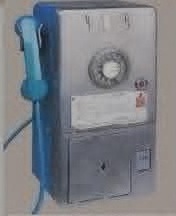
| Name | 103 series |
| Date | 1980 |
| Manufacturer | Directorate General of Telecommunications (DGT), the 103-STD was manufactured by Tongya Telecommunication Industry Co. Ltd. (東亞通信工業). Tongya, founded in 1969 as a joint venture with Japan’s Tamura Electric |
| Link | Similar model developed in Japan by Anritu |

Development of the Taiwan Rotary Coin Payphone 103 series
103B Public Payphone (left)
Introduced during the early 1980s, the 103B was Taiwan’s standard push-button coin-operated public telephone. It replaced earlier rotary models with DTMF dialling, offering faster call setup and improved reliability. Manufactured for the national telephone network, it became one of the country’s most recognisable stainless-steel payphones during the 1980s.
103-STD Public Payphone (centre)
The 103-STD was a rotary-dial public payphone adapted for Subscriber Trunk Dialling (STD), allowing users to place long-distance domestic calls without operator assistance. Based on the standard 103-series design, it represented Taiwan’s transition towards fully automatic nationwide telephone service during the 1970s and early 1980s.
TW-620P Public Payphone (right)
The TW-620P was a later-generation Taiwanese public payphone introduced during the late 1980s. Featuring a modern push-button keypad and updated electronics, it improved reliability and maintenance over the 103 series. It remained widely deployed until card-operated and digital public telephones gradually replaced traditional coin-operated models.
Development of the 103-STD Series
The 103-STD Series represented the final evolution of Taiwan’s rotary-dial coin-operated public telephones. Introduced during the 1980s, the model combined the proven reliability of earlier rotary payphones with refinements that kept the design competitive as Taiwan’s telephone network rapidly expanded. While electronic keypad telephones were beginning to emerge, rotary exchanges still formed a substantial part of the national network, ensuring that the 103-STD remained an important and widely deployed public telephone throughout the decade. It provided both local and Subscriber Trunk Dialling (STD) services, allowing users to place domestic long-distance calls directly without operator assistance.
Mechanically, the 103-STD retained the rugged construction that had characterised earlier Taiwanese payphones. Separate NT$1 and NT$5 coin slots fed independent coin paths, where each coin was mechanically checked for size, weight and composition before being accepted. An innovative security feature automatically closed the coin entry whenever the removable cash box was withdrawn, preventing access to deposited coins and significantly reducing theft and fraud. This robust, low-maintenance design made the telephone well suited to heavy public use in railway stations, post offices, government buildings and busy commercial areas.
Although surviving examples are marked only with the insignia of the Directorate General of Telecommunications (DGT), the strongest available evidence suggests the 103-STD was manufactured by Tongya Telecommunication Industry Co. Ltd. (東亞通信工業). Tongya, founded in 1969 as a joint venture with Japan’s Tamura Electric, states that it produced Taiwan’s first coin-operated public telephone in 1970 and became the principal supplier of public telephones to the DGT. The 103-STD’s engineering, modular construction and overall styling are consistent with this heritage and show clear similarities to contemporary Japanese Tamura designs. While original procurement records have yet to be located, Tongya is the most probable manufacturer. By the late 1980s, the 103-STD was gradually superseded by electronic push-button models such as the TT-630, but it remained one of the last and most refined rotary payphones to serve Taiwan’s public telephone network.

Leave a Reply