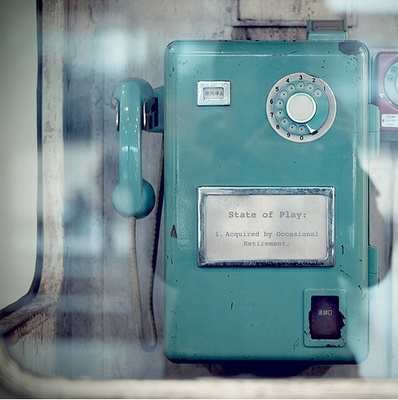
| Name | 大型青電話機 (Ōgata Ao Denwa-ki) literally: “Large Blue Public Telephone” or “Large-Type Blue Telephone.” |
| Date | 1968 |
| Manufacturer | Anritsu Japan for NTT. |
| Links | Exported to Greece, Malaysia and Singapore and used extensively in Australia as the CT3 Payphone. Similar model developed in Taiwan by TTI |


Development of the Large Blue Payphone
| The 1968 Japanese “blue phone” was developed in response to the explosive growth of direct-dial long-distance calling across Japan. Following the success of the earlier large “red phone,” the public increasingly wanted telephones capable of nationwide subscriber trunk dialling to be available at all hours in public spaces. Rather than being used casually on counters or inside shops, the blue phone was specifically designed for installation inside public telephone booths positioned on busy streets, outside railway stations, and in major urban centres. Manufactured by Anritsu for Japan’s national telecommunications authority, the blue phone combined advanced long-distance dialling capability with the ruggedness needed for unattended public use. Introduced commercially in December 1968 after field testing in Tokyo, Osaka and Sapporo, the telephone quickly became a familiar feature of the Japanese streetscape. Large numbers were installed in fully enclosed glazed booths, although some were also mounted in simpler pole-type shelters where space was limited. The phone itself reflected the clean industrial modernism of late-1960s Japanese design. Its bright blue colour distinguished it from the earlier red models while visually signalling its enhanced long-distance capability. The robust metal body, reinforced handset and heavy-duty coin mechanism were intended to withstand constant public use. The design proved highly influential internationally. Variants of the system were later exported throughout Asia and formed the technological basis for the Australian CT3 public telephone developed in cooperation with Anritsu during the early 1970s. Below- export versions in Greece, Malaysia and Singapore. |


Below- model developed in Australia


Leave a Reply