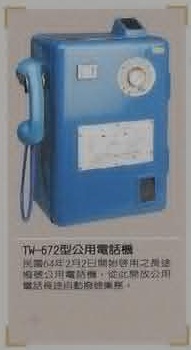
| Name | TW-672 Payphone TW15 (672) Automatic Coin-Operated Long-Distance Dialing Public Telephone |
| Date | 1975 |
| Manufacturer | Tongya Telecommunication Industry Co. Ltd. (東亞通信工業). Founded in 1969 as a joint venture with Japan’s Tamura Electric, |
| Link | Similar model developed in Japan by Anritu |


Development of the Taiwan Rotary Coin Payphone TW-672
The TW-672 was one of Taiwan’s most important rotary-dial public telephones, introduced in 1975 to support the nationwide expansion of Subscriber Trunk Dialling (STD). Unlike earlier local-only coin telephones, the TW-672 enabled users to dial domestic long-distance calls directly without operator assistance, marking a significant advance in Taiwan’s public telecommunications network. The National Science and Technology Museum identifies the model as the TW15 (672) Automatic Coin Long-Distance Public Telephone, developed specifically for both local and direct long-distance service.
The telephone featured a robust blue pressed-steel cabinet with a heavy-duty rotary dial that generated pulse signals for automatic exchanges. Its mechanical coin mechanism incorporated separate NT$1 and NT$5 coin slots, each feeding an independent coin path where coins were validated by size, weight and material before being accepted. A particularly ingenious anti-theft feature automatically closed the coin entry when the cash box was removed, preventing unauthorised access until the sealed coin box was opened by authorised staff. This design greatly reduced opportunities for fraud and theft while simplifying collection procedures.
Although surviving examples carry only the markings of the Directorate General of Telecommunications (DGT), the available evidence strongly suggests the TW-672 was manufactured by Tongya Telecommunication Industry Co. Ltd. (東亞通信工業). Founded in 1969 as a joint venture with Japan’s Tamura Electric, Tongya states that it produced Taiwan’s first coin-operated public telephone in 1970 and became the principal supplier of public telephones to the DGT. The TW-672’s modular construction, stainless-steel internal components and overall engineering also display clear similarities to contemporary Japanese Tamura designs. While definitive factory documentation has yet to emerge, Tongya is the most likely manufacturer based on its documented history and market position. The TW-672 remained in widespread service throughout the late 1970s and 1980s before being progressively replaced by electronic keypad models such as the TT-630.
Leave a Reply