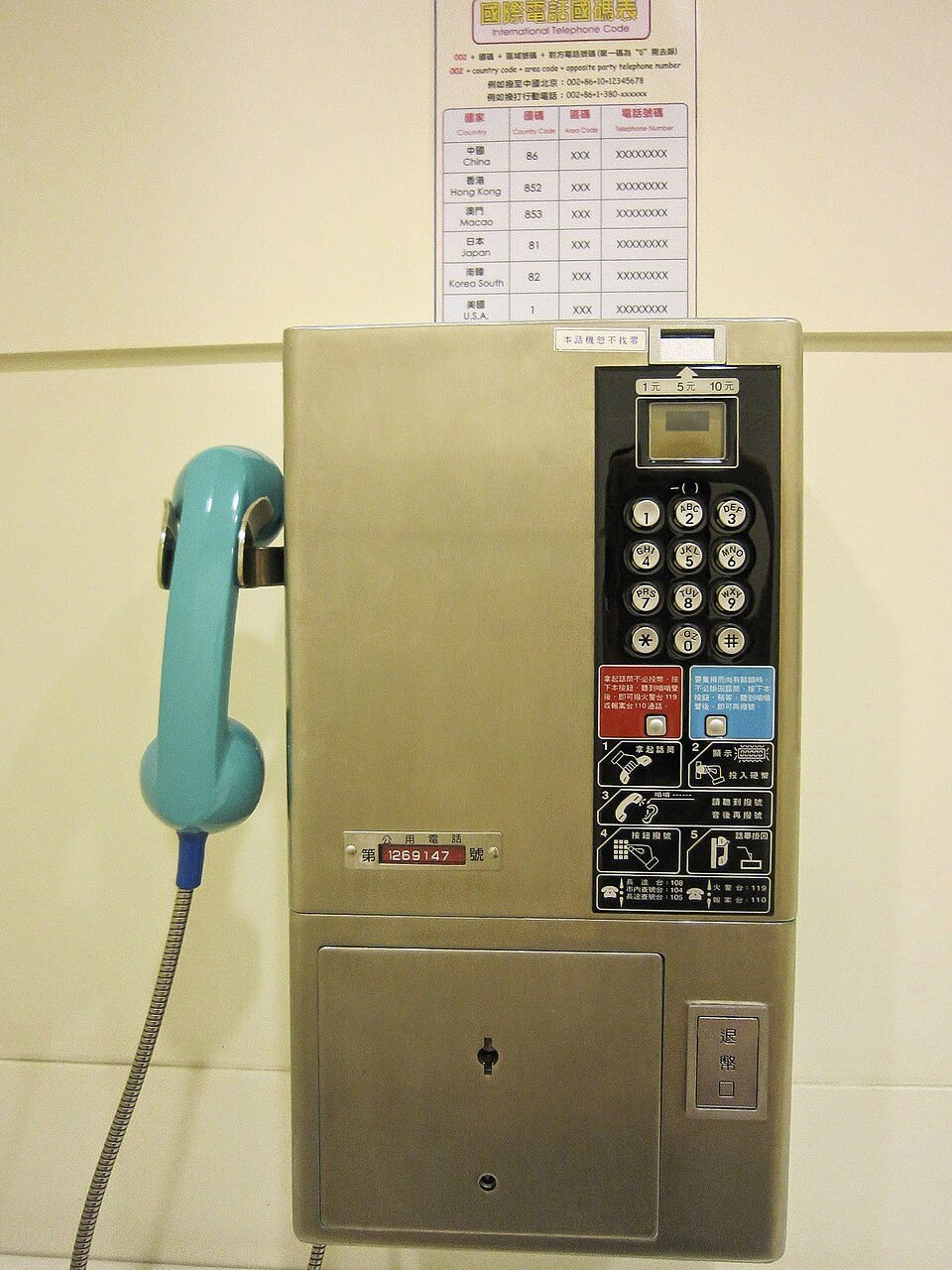
| Name | 113-STD |
| Date | June 1987 |
| Manufacturer | manufactured by Tongya Telephone Co., Ltd. for the Directorate General of Telecommunications (DGT) |


Development of the Taiwan Rotary Coin Payphone 113-STD
The 113-STD Public Telephone (113-STD 公用電話機) represented the next major step in Taiwan’s payphone development, replacing the earlier rotary-dial 103 Series with a fully electronic, push-button design. Introduced in June 1987, the 113-STD was manufactured by Tongya Telephone Co., Ltd. for the Directorate General of Telecommunications (DGT), Taiwan’s national telephone authority. It remained a common sight throughout the late 1980s and 1990s before gradually being superseded by IC card and smart card telephones.
Constructed with a heavy stainless-steel cabinet, the 113-STD was designed to withstand vandalism and Taiwan’s humid subtropical climate. Calls were made using a twelve-button keypad with DTMF (touch-tone) signalling, providing much faster dialling than the earlier rotary models. A small LCD display showed call status and remaining credit, while the electronic coin mechanism accepted NT$1, NT$5 and NT$10 coins. The large lower compartment housed the secure coin vault, accessed only by authorised telephone company staff.
The instruction panel beside the keypad guided users through the operating sequence and listed Taiwan’s emergency numbers, including 110 (Police), 119 (Fire and Ambulance), 104 and 105 (directory assistance), and 108 (long-distance operator). A dedicated coin return button allowed unused coins to be refunded.
Although mechanically simpler than later card-operated models, the 113-STD was a highly reliable electronic payphone that bridged the transition between Taiwan’s electromechanical era and the digital public telephone network. Its robust construction, clean industrial styling and dependable operation made it one of the most recognisable Taiwanese public telephones of the late twentieth century.


Leave a Reply