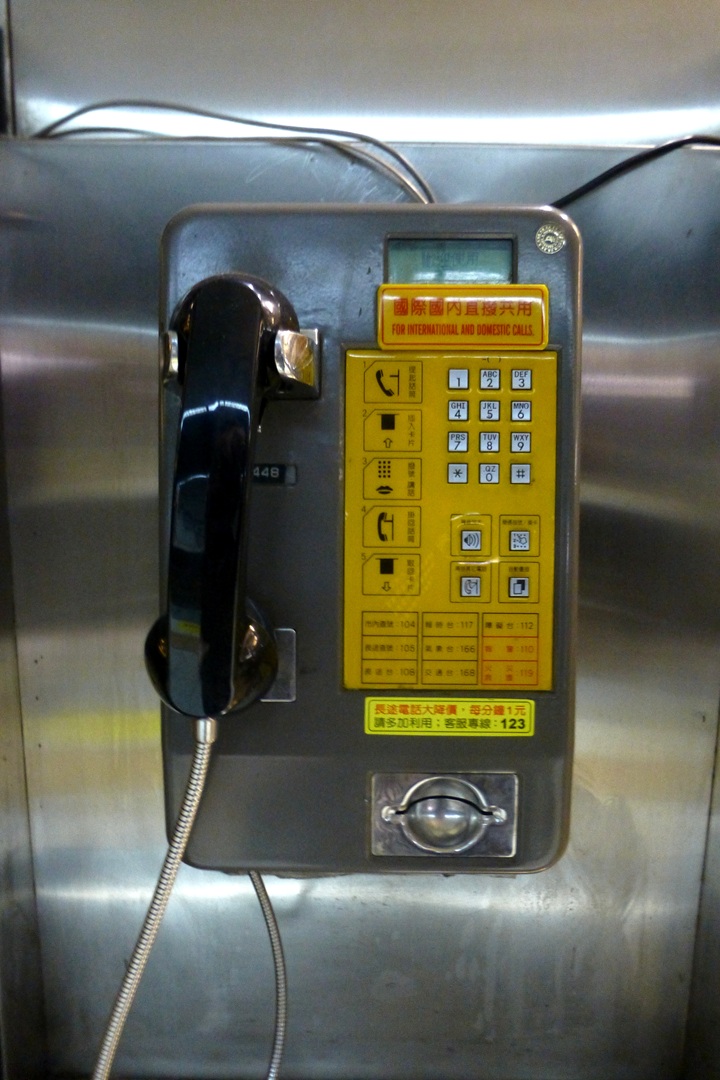
| Name | TTC-1 IC Card Public Telephone (TTC-1 IC卡式公用電話機) |
| Date | 1990s |
| Manufacturer | manufactured by Tongya Telephone Co., Ltd. for the Directorate General of Telecommunications (DGT) |

Development of the Taiwan TTC-1 IC Card Public Telephonee
The TTC-1 IC Card Public Telephone (TTC-1 IC卡式公用電話機) marked Taiwan’s transition from coin-operated payphones to stored-value smart card technology during the early 1990s. Manufactured by Tongya Telephone Co., Ltd. for the Directorate General of Telecommunications (DGT), the TTC-1 accepted IC (integrated circuit) telephone cards rather than coins, making calls faster, more reliable and less vulnerable to vandalism or coin theft. A liquid crystal display provided call information and remaining card credit, while a DTMF keypad supported both domestic and international direct-dialling.
In design, the TTC-1 clearly reflects the influence of the Landis & Gyr optical phonecard payphone family developed in Europe during the late 1980s. The overall cabinet proportions, handset mounting, LCD position and modular front panel closely resemble Landis & Gyr products, although the Taiwanese version was extensively redesigned for IC card technology rather than optical memory cards. Taiwan adopted IC cards as its national standard, resulting in a distinct local evolution rather than a direct copy of the European system.
The rugged cast-metal housing retained the robust construction of earlier Tongya payphones while incorporating electronic control systems and programmable software. Function buttons allowed card return, redial and speaker volume adjustment, while prominent bilingual instructions simplified operation.
Unlike Landis & Gyr’s European models, there is little evidence that the TTC-1 achieved significant export sales. Available information suggests it was developed primarily for Taiwan’s domestic telecommunications network, where it remained a familiar sight throughout the 1990s before gradually being replaced by multi-function card, credit card and eventually mobile telephone services.


Leave a Reply