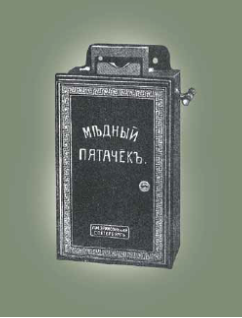
| Name | L. M. Ericsson “Medny Pyatachok” (Медный пятачок, “Copper Five-Kopeck Piece”) |
| Date | c. 1903 |
| Manufacturer | Russian Joint-Stock Company L. M. Ericsson & Co. at its St Petersburg telephone factory. |


L. M. Ericsson “Medny Pyatachok”
The L. M. Ericsson “Medny Pyatachok” (Медный пятачок, “Copper Five-Kopeck Piece”) was an early coin-collecting telephone attachment used in the Russian Empire. Ericsson-system automatic telephones were introduced in Russia from about 1903, with equipment manufactured locally by the Russian Joint-Stock Company L. M. Ericsson & Co. at its St Petersburg telephone factory.
The device was not a complete payphone in the later sense, but a money-box mechanism attached to an ordinary telephone operating through a manual exchange. It accepted a copper five-kopeck coin and incorporated a current interrupter which signalled the operator that payment had been made. A mechanical counter recorded the number of paid conversations. Ericsson also supplied a cheaper cast-iron version accepting 5, 10 and 15 kopeck coins.
The design was part of Ericsson’s wider international range of coin collectors. In Britain, for example, Ericsson supplied the closely related Coin Collecting Box No. 1, listed in its 1902 catalogue as product No. 441; its descendants were subsequently adopted by the British GPO. This suggests that the Russian apparatus was a locally adapted member of Ericsson’s international family of operator-controlled coin-collection systems rather than an entirely Russian invention.
The Ericsson principle proved remarkably durable. After the 1917 Revolution, Ericsson-design automatic telephones continued to be manufactured by the Soviet Krasnaya Zarya and Kaluga factories, with a surviving 1926 example preserved in the A. S. Popov Central Museum of Communications.
Leave a Reply