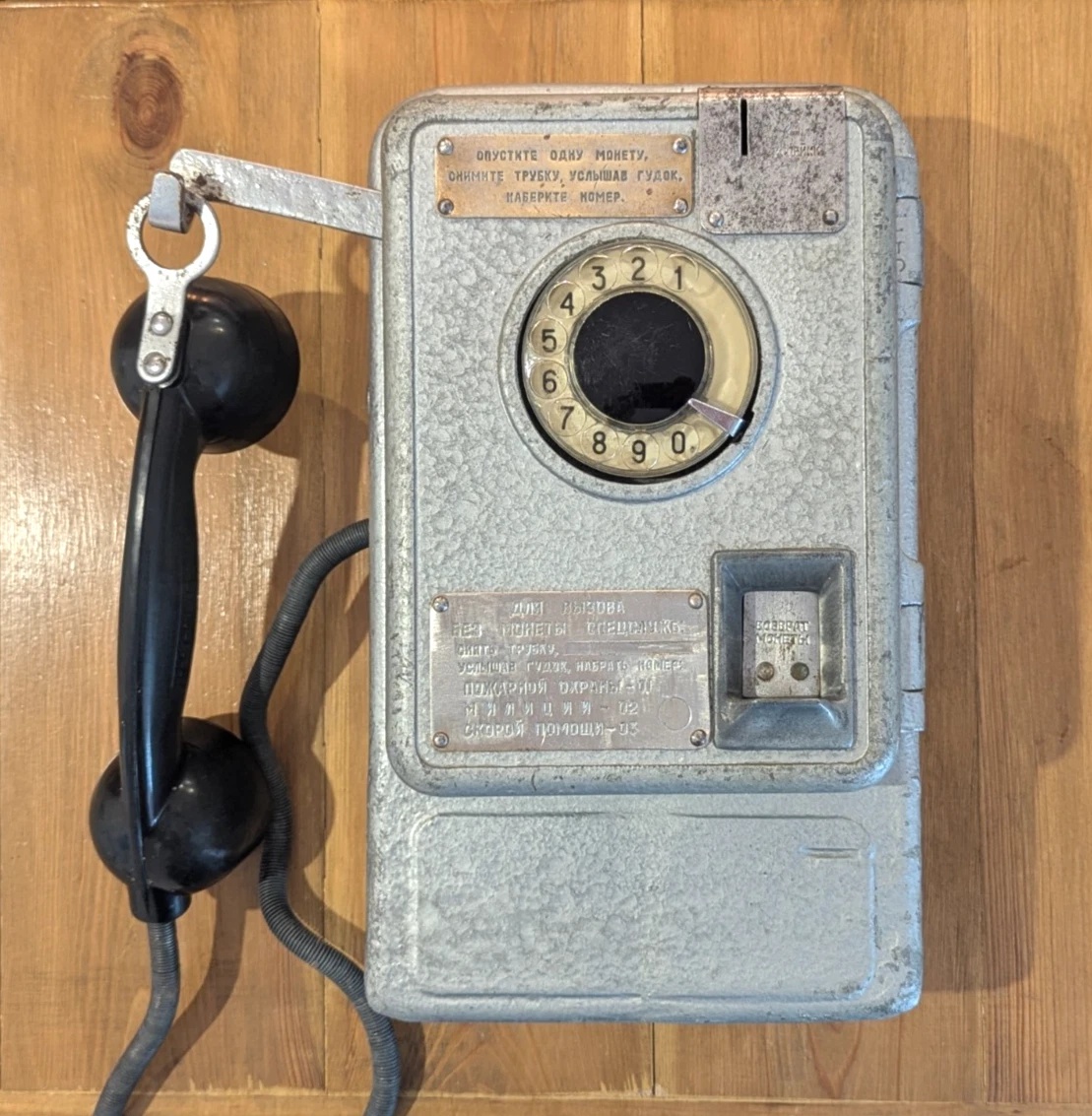
| Name | AMT-47 Soviet Payphone |
| Date | 1947 |
| Manufacturer | Krasnaya Zarya Telephone Works, Leningrad (early production); subsequently Perm Telephone Factory, Perm (large-scale production, c.1957–1972). |
| Credit | Additional information at Moscow based payphone museum website- https://amt69.ru/ |
| Link | Similar version manufactured in Poland in the 60s. |


AMT-47 Soviet Payphone
The AMT-47 was one of the most recognisable public telephones of the post-war Soviet Union. Its official designation was simply AMT — Avtomaticheskiy Monetnyy Taksofon (Автоматический Монетный Таксофон), or Automatic Coin Payphone. “AMT-47” is actually a later, unofficial name: the 47 refers to 1947, when development of the design was apparently completed. The suffix became useful only after the later AMT-69 appeared, allowing collectors and technicians to distinguish the two generations.

Production began during the 1950s and continued until 1972, giving the AMT an unusually long service and manufacturing life. Over those two decades numerous modifications appeared, generally simplifying and strengthening the design. The heavy metal casing, weighing around 9 kg, was designed for intensive public use. Earlier machines could be finished in a very dark, almost black colour with a blue tint, while the familiar later examples were generally finished in durable silver-grey hammer enamel.
AMTs were installed widely in street telephone booths and public locations throughout Soviet cities, becoming a familiar element of the USSR’s post-war streetscape. The massive casing, rotary dial and heavy handset made the telephone particularly suitable for unattended public operation. The Moscow AMT-69 Payphone Museum describes the AMT as an icon of Soviet industrial design whose silhouette became familiar through Soviet black-and-white films.
An interesting feature was its removable coin box or kopilka. The AMT’s coin-box dimensions subsequently became the standard used for later Soviet payphones, including the AMT-69, although the internal construction differed. The AMT-47 coin box itself had no lock; provision was instead made for a plasticine security seal.
Early AMTs had a comparatively elegant carbolite handset marked “Телефон-автомат” (Telephone-Automatic). Theft and vandalism became a serious problem—receiver components were reportedly even taken to obtain coils for homemade electric guitars—so later handsets were secured with substantial steel chains. Eventually a heavier carbolite handset with distinctive burgundy-coloured earpieces and the characteristic suspension ring became standard.
Another useful dating feature is the coin-entry plate. Early machines had a flat plate, with either vertical or angled coin slots, whereas later versions had a curved plate wrapping over the upper edge of the casing. Before the 1961 Soviet currency reform, a call cost 15 kopeks. Afterwards existing machines were centrally converted to accept 2 kopeks, and their denomination plates were replaced accordingly.
The front also carried operating instructions: insert a coin, lift the receiver, wait for the dial tone and dial the number. Emergency calls could be made without payment: 01 fire, 02 police and 03 ambulance.
There were further variations, including early and later coin-return button arrangements. A particularly rare relative was the RMT, externally similar to the AMT but lacking a rotary dial. It was intended for connection to manually operated exchanges, where the caller asked an operator to connect the required number.
AMT was initially manufactured at the Krasnaya Zarya (“Red Dawn”) telephone factory in Leningrad (today St Petersburg). Production there appears to have been relatively limited. A specialist Russian telephone-history source reports a surviving 1955 Krasnaya Zarya AMT with serial number only around 1100.
Production was then transferred to the Perm Telephone Factory (Пермский телефонный завод / PTZ) in Perm, in the Urals. Particularly convincing evidence comes from research in the factory archive: surviving engineering drawings for the “coin telephone apparatus type AMT,” drawing РГ2.184.004, are dated 1957, apparently marking the beginning of large-scale Perm production. A 1960 example already carries serial number 33,221, suggesting production increased dramatically after the transfer.
There is some disagreement over the exact Perm starting date. Some secondary sources say 1950, while the archival evidence points more convincingly to 1957 for serial production. Production continued at Perm until about 1972.
Interestingly, the cast body components were apparently made by several foundries around Perm, rather than entirely within the telephone factory. One specialist reports that the original AMT body moulds were still stored at the Kalinin Factory in Perm as late as 2006.
There was also a Polish-built relative, the Telos AW-652, but I would describe that as a Polish derivative/licensed version rather than simply another Soviet AMT factory.


Below- The German Münzfernsprecher 26 that is was based on.


Leave a Reply