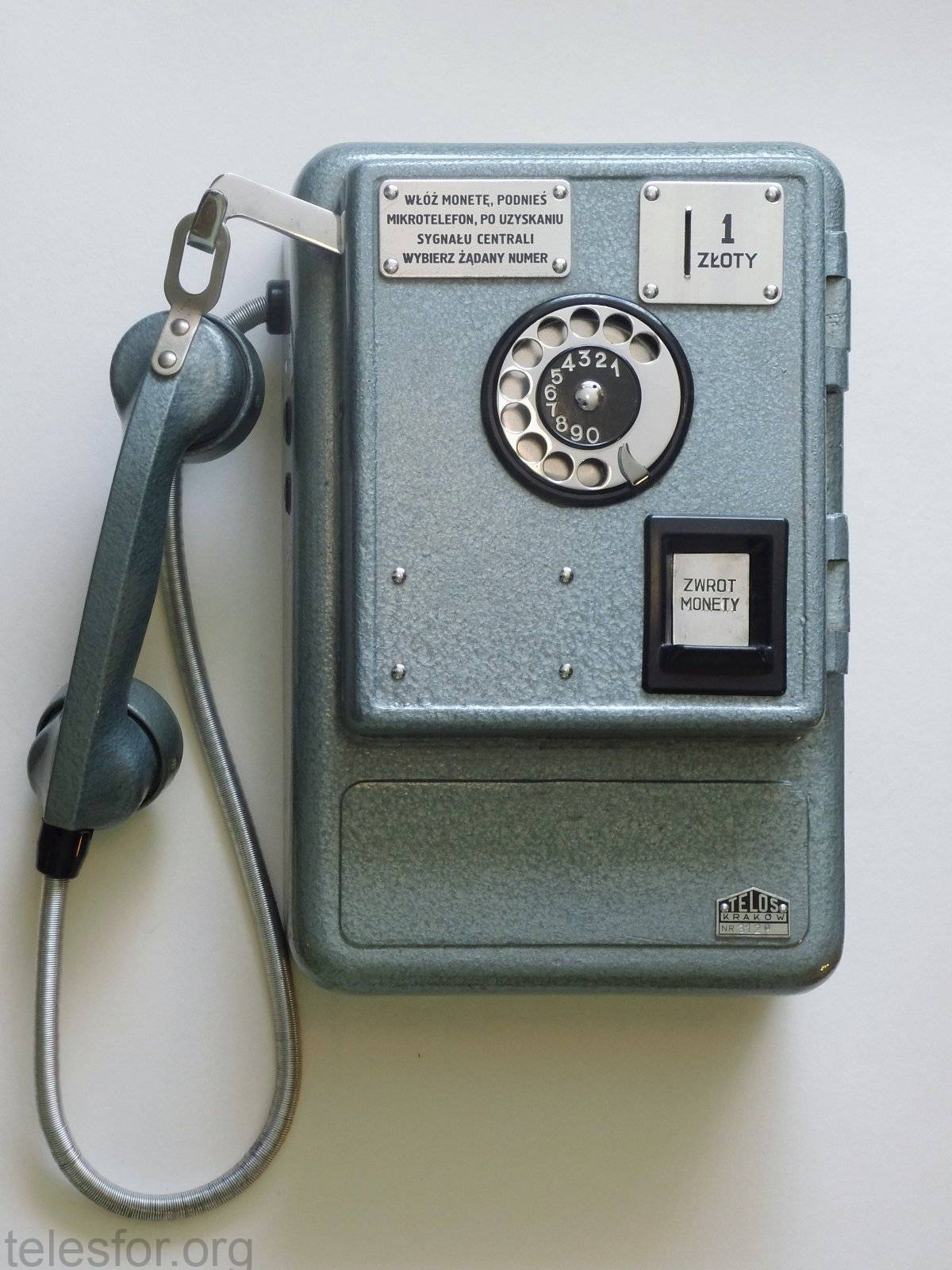
| Name | Telos AW-65 (AW-652) |
| Date | 1962 |
| Manufacturer | Telos of Kraków |
| Credit | For information and images on Polish payphones, special thanks to our friends at https://telesfor.org/ |
| Link | Design based on the Russian version AMT-47 Soviet Payphone (model 10 years earlier). Exterior very similar but internal mechanisms more advanced in the Polish version. |
Telos AW-65 / AW-652 Polish Payphone
The Telos AW-65, and its improved AW-652 version, was one of the characteristic Polish public telephones of the communist era. Manufactured by Telos of Kraków, it belonged to a family beginning with the AW-60 (1962–63), followed by the AW-63 (1964–66) and AW-65 from about 1967 into the late 1970s.
The AW-65 was a rugged, coin-operated telephone intended primarily for local calls. Its substantial cast aluminium-alloy case contained a separately locked steel cashbox. Depending on configuration, the mechanism accepted a single denomination—50 groszy or 1, 2 or 5 złoty. Coins were mechanically checked for dimensions and magnetically tested. The caller inserted the coin before lifting the handset; it remained temporarily held until the called party answered. The automatic exchange then reversed the line polarity, causing the coin to be collected. If the call was unanswered, the coin dropped into the “Zwrot monety” (coin return).


The AW-652, introduced around 1967 and covered by a 1966 patent, refined the electrical system and coin discrimination and improved reliability. It also dealt with incoming calls: earlier machines could mistakenly attempt to collect money when polarity changed. The new circuit provided a period during which an incoming call could be answered free of charge.
Perhaps its most striking feature was its extraordinary aluminium handset, with an almost industrial, sculptural appearance and a flexible armoured metal cord. Together with the hammered grey finish, it made the AW-65 exceptionally robust.

Above image- Warsaw 1975
Although manufactured and electrically developed in Poland, its ancestry appears strongly Soviet. The casing and basic arrangement closely resemble the Soviet AMT-47, introduced around 1950—more than a decade before the AW-60. The Polish telephone was therefore probably not an entirely indigenous design, but a substantially modernised Polish development of an existing Soviet concept. Internally, however, Polish components, circuitry and successive mechanical improvements increasingly distinguished it from its Soviet predecessor.
The AW-65 family survived into the early 1980s before being superseded by the Telos AW-7, and surviving examples are now relatively uncommon.


Above- the famous Polish actress Nina Gocławska using an AW-65 at the pool
Below- the Russian version AMT-47 Soviet Payphone


Leave a Reply