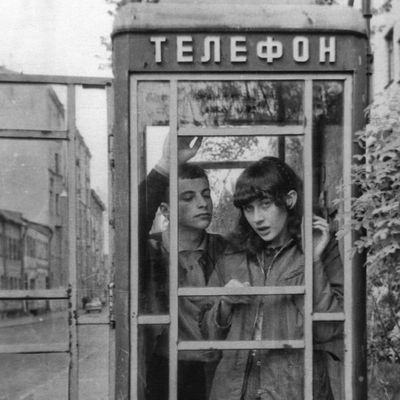
| Name | Russian public telephone booths |
| Date | 1901-2026 |


Russian Phone Boxes- the early Soviet period
Moscow’s public telephone story began soon after the arrival of the telephone itself. On 1 July 1882, the Bell international telephone company opened a station near Kuznetsky Most, with just 28 subscribers. The following year the idea of allowing the public to make calls for a fee was proposed, but the Moscow City Duma repeatedly rejected proposals for public telephones for the next twenty years.
Public telephones had appeared at Paris railway stations in 1901, and Moscow finally followed in 1903, when its telephone network had reached approximately 3,000 subscribers. By decision of the Moscow City Council, eight Swedish-made public telephone booths were installed in prestigious and heavily frequented locations, including large shops, restaurants, theatres and pharmacies. Calls were paid for using 10- and 15-kopeck silver coins.
The network expanded quickly. One account records 28 Moscow payphones by 1909, with another 17 in the surrounding Moscow region. Figures vary between contemporary accounts, but the number continued rising: 23 booths were recorded by 1912 in one source, while another gives 60 payphones in that year and 93 by 1915.
These early booths were substantial enclosed kiosks, providing shelter, privacy and protection for the telephone equipment. Later Soviet examples developed into the familiar narrow glazed booth, generally with a metal or timber frame, glazed door and windows, and prominent ТЕЛЕФОН (“TELEPHONE”) lettering above the entrance. Larger installations could contain several booths grouped together, while particularly busy locations sometimes had rows of individual kiosks.
The Revolution and subsequent disruption of the telephone system reversed this expansion. By 1921 only ten public telephones remained in Moscow, practically one for each district. Nevertheless, the concept suited the new Soviet government’s vision of communications as a universally accessible public service. The payphone therefore survived and ultimately became an important component of Soviet urban infrastructure.
During the 1930s Moscow had approximately 810 payphones, with a local call costing 10 kopecks. In the following decade, public telephony was supplemented by apartment payphones intended particularly for communal apartments. These had no monthly subscription fee; users instead paid 2 kopecks for each call.


Russian Phone Boxes- the Post-WWII – AMT-47 Era
After the Second World War, the Soviet Union began rebuilding and expanding its telephone networks and automatic exchanges. This period also marked the transition from earlier and imported public-telephone equipment to domestically manufactured machines. In 1947 Soviet industry introduced the AMT-47, which would remain a standard Soviet payphone for more than twenty years. Mass production was undertaken by the Perm Telephone Plant from 1950 until approximately 1970.
The AMT-47 was a sophisticated and unusually robust coin-operated telephone designed specifically for Soviet public use. Its aluminium-alloy casing was intended to resist theft and forced entry and was divided internally into two isolated sections: one containing the telephone and coin mechanism and another containing the locked cash box. The maintenance mechanic had no access to the accumulated coins. The key to the money-box compartment was retained at the district communications centre and issued to the collector only when collections were made.
The AMT-47 was engineered for the Soviet Union’s extreme climatic range and could operate at temperatures from approximately −40°C to +50°C. Initially a call cost 15 kopecks. Following the 1961 currency reform and introduction of new tariffs, the enormous installed network of AMT-47s was modified to accept the newly issued 2-kopeck coin, popularly known as the dvushka. The two-kopeck public-telephone tariff subsequently remained unchanged for around thirty years.
The AMT-47 rollout initially concentrated on cities as the post-war telephone network was reconstructed, but eventually extended to cities throughout the USSR. The machines were not confined to conventional street kiosks. They could be mounted openly on walls or stands in building entrances, vestibules, railway stations and other public spaces, making the telephone available wherever sufficient shelter and public traffic existed.
Outdoors, however, the AMT-47 became closely associated with the classic Soviet ТЕЛЕФОН booth. Early post-war kiosks were principally wooden or metal enclosed structures, generally narrow and rectangular, with extensive glazing and a glazed entrance door. The telephone was mounted against the rear or side wall. These booths provided privacy and some protection from wind, rain and snow, although photographs demonstrate that Soviet callers sometimes had to contend with extraordinary winter conditions.
From 1957, production began of more durable and reliable prefabricated reinforced-concrete telephone booths. These retained a glazed metal door and large glazed openings but used a concrete shell to withstand weather, heavy public use and vandalism. Double units were also produced, allowing two payphones to be installed side-by-side within a single structure.
By the 1960s, the combination of the AMT-47 and the standardized Soviet booth had made the public telephone an instantly recognizable part of streets, housing estates, stations and public spaces across the USSR.


Russian Phone Boxes- the Modern Day era
From around 1970, the ageing AMT-47 network began to be replaced by the new AMT-69, which became one of the characteristic Soviet and later Russian public telephones. The long-established 2-kopeck local-call tariff continued for approximately thirty years, helping make public telephones an inexpensive and widely accessible service.
The Soviet-era booth evolved alongside the telephone. By the late Soviet period Moscow used both fully enclosed booths and open or semi-enclosed “half-booths.” A generation of booths designed in 1980 remained on Moscow streets for many years, although by the late 1990s they were ageing and increasingly requiring replacement.
The collapse of the Soviet Union brought a rapid transformation in both payment systems and equipment. From 1993, Moscow public telephones began operating with tokens rather than Soviet coins. Token machines nevertheless created serious problems. They became targets for thieves seeking tokens for resale, and forced entry often damaged the telephone beyond economical repair. Counterfeit tokens also caused MGTS losses and damaged public confidence because users frequently assumed that a machine was defective when it rejected a counterfeit. Collecting tokens from thousands of machines was itself expensive.
A transition to electronic cards therefore followed. At the end of 1995, 300 card-operated payphones manufactured by the French company Monetel were installed. At the time of the source account, Moscow possessed approximately 30,000 token-operated and 1,000 card-operated public telephones, with token equipment scheduled for gradual withdrawal.
Another important supplier was Amper of Spain, which manufactured card-operated payphones for Moscow. These were installed principally in the Metro and along major central roads. Amper machines underwent rigorous testing by a specialist MGTS unit, particularly for vandal resistance. Although technologically advanced and expensive, they were considered to have no cheaper alternative offering equivalent quality. Moscow’s card telephones increasingly used microchip or “chip” cards, providing substantially greater security than earlier systems.
Moscow nevertheless had several public-telephone operators besides MGTS, including MMT, Comstar and Atel, creating the problem of incompatible cards. The Russian Federation’s Committee for Communications and Informatization consequently considered introducing a unified payphone card for Moscow. Lower-value cards were also introduced to make the service more affordable. At the time, a minute using an MGTS payphone card cost 667 rubles.
Counterfeit cards created another problem. Large numbers of counterfeit cards from an earlier series forced city payphones to be disconnected temporarily from long-distance and international calling, because MGTS was obliged to pay the long-distance network operators even when it received no legitimate revenue from the fraudulent cards. Although the technical problem had not then been completely resolved, restoration of intercity and international calls was anticipated.
The booths themselves were also modernised. The older enclosed and semi-open designs dating from 1980 were deteriorating, and 250 new triangular booths had already been installed. These were doorless, silver-steel structures with large windows, representing a shift away from the traditional enclosed Soviet kiosk. Foreign booth designs were considered too expensive and insufficiently robust for Moscow’s climate and social conditions. New Russian booths therefore incorporated high-impact glazing, including tempered laminated triplex glass up to 9 mm thick, together with concealed screws to discourage vandalism.
Maintaining such an extensive network required dedicated teams of electricians. Each technician was responsible for as many as 110 payphones, which received daily attention. Metro machines were inspected twice daily, because users frequently inserted foreign objects in place of tokens and the intensely used equipment could otherwise fail within a day.
For Moscow’s 850th anniversary, MGTS issued commemorative telephone cards depicting old and modern Moscow, while both payphones and booths received anniversary decoration. The Moscow City Telephone Network was simultaneously undertaking a major modernisation programme. Its target was to provide residents and visitors with approximately 8,500 card-operated public telephones by 2000, marking the final transition from the Soviet coin-operated street telephone to the electronic-card network of post-Soviet Moscow.
Leave a Reply