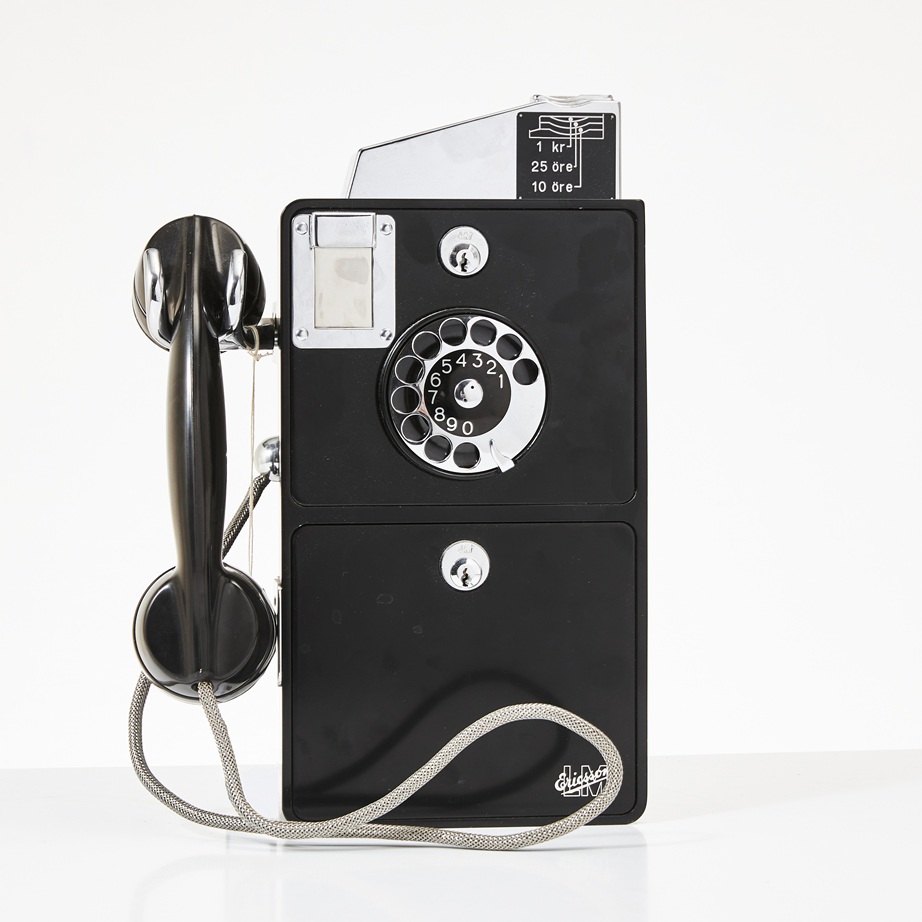
| Name | DMT 141–143 three-coin payphone family |
| Date | c. 1960s |
| Manufacturer | L.M. Ericsson for Televerket |
DMT 141–143 three-coin payphone family
The L.M. Ericsson DMT 141–143 family represents a classic generation of Swedish public telephones from around the 1960s, combining Ericsson’s exceptionally robust engineering with restrained Scandinavian functionalist design. These wall-mounted sets were designed to accept three Swedish coin denominations, typically 10 öre, 25 öre and 1 krona, allowing different combinations of coins to be used according to the cost and duration of the call.
The telephone was built around a substantial metal cabinet divided into two secure compartments: the upper section containing the telephone and coin-control mechanism, and the lower section forming the locked cash compartment. Coins were inserted through the prominent mechanism projecting above the cabinet. The rotary dial, Bakelite-style handset and armoured handset cord reflect the need for durability in unsupervised public locations.
Different versions within the DMT 141–143 series accommodated variations in installation and operating requirements. Surviving examples occur in both black and light grey finishes, the latter giving the telephone a distinctly more modern 1960s appearance.
Manufactured by L.M. Ericsson of Sweden, the DMT series belongs to the period when Ericsson was one of the world’s leading telecommunications manufacturers. Today these imposing mechanical coin telephones are particularly attractive examples of mid-century Swedish industrial design.


Leave a Reply