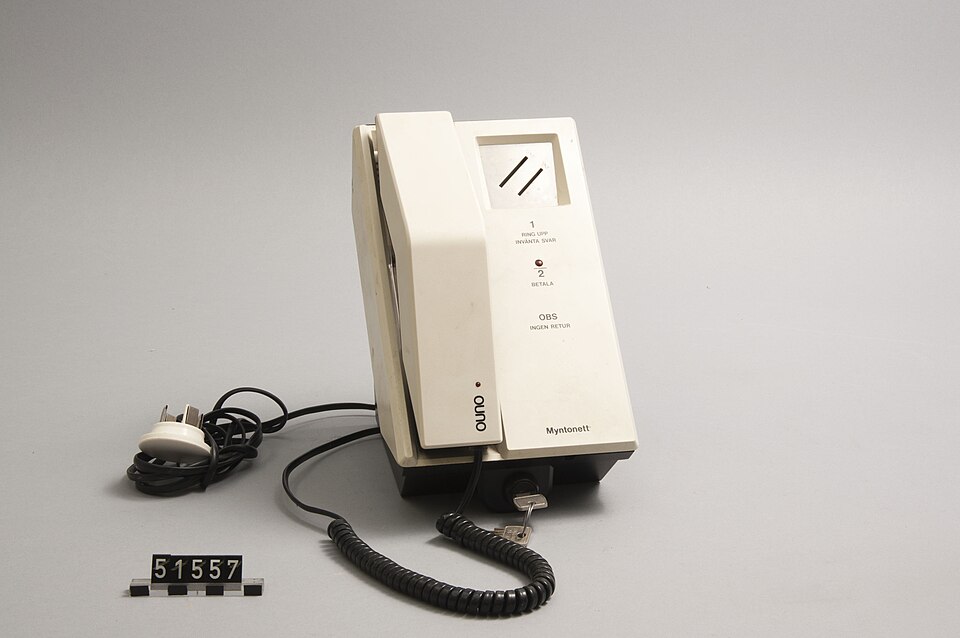
| Name | Myntonett Televerket |
| Date | 1991. Also sold in the UK under a different name. |
| Manufacturer | Myntonett |
Myntonett Televerket
The Myntonett was a privately owned Swedish coin telephone supplied through Televerket around 1990–91. Unlike Televerket’s public street payphones, it was intended for businesses wishing to offer customers controlled access to a subscriber line. The carton promoted it as “the coin telephone that improves your customer service,” suggesting use in hotels, restaurants, shops, workplaces and similar interiors.
Operation was simple. The caller lifted the Ouno push-button handset, dialled the number and waited for an answer before inserting payment. The two slots accepted 5-krona and 1-krona coins. A red indicator assisted the payment process, while the warning “OBS – INGEN RETUR” made clear that inserted coins would not be returned. A card beside the handset allowed the proprietor to state the telephone number and charges for local, long-distance and mobile calls, and whether incoming calls were barred.
The locked casing housed the coin mechanism, collection compartment and adjustable controls, with settings for retaining or rejecting coins and selecting call charges. It required both a telephone connection and mains power. Its angular cream-and-black plastic body typifies Scandinavian telecommunications design of the period. Televerket records identify it as an abonnentägd mynttelefon—subscriber-owned coin telephone—and date its manufacture to 1991, shortly before Televerket became Telia.


Leave a Reply