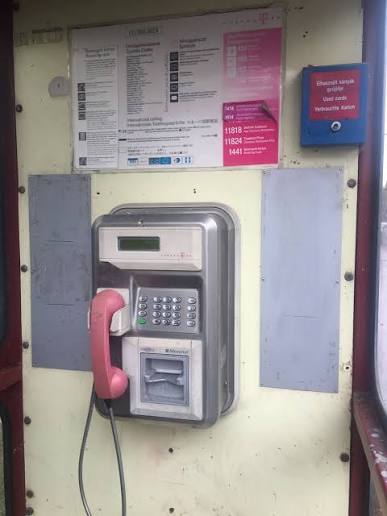
| Name | Ascom Monétel card phone |
| Date | mid 1990s |
| Manufacturer | Ascom Monétel |
| Credit | With thanks to- www.postamuzeum.hu |


Ascom Monétel card phone
The IPTHH-403 was a card-operated public telephone used in Hungary during the 1990s. Budapest’s Telefónia Museum identifies its example as manufactured in 1998 by Monétel. The photographed instrument carries both Ascom Monétel branding and the emblem of Mechanikai Művek, providing visible evidence of a Hungarian industrial connection alongside the international manufacturer’s name. The museum’s date applies to its particular specimen, rather than necessarily marking the model’s introduction. Postamúzeum
Its substantial silver-grey housing has a distinctive arrangement: an LCD screen at the top, a recessed metal pushbutton keypad in the centre, and a telephone-card reader below. The handset hangs on the left, attached by an armoured cord. Additional controls flank the numbered keys, while simple pictograms illustrate the sequence of lifting the receiver, inserting a card and dialling.
The museum example has a blue handset and Matáv branding. Your street photographs show similar instruments with pink handsets inside magenta-framed booths bearing Telekom signage, documenting their appearance under later operator branding.
Hungary’s first telephone cards appeared in 1991, initially around Lake Balaton. This instrument belongs to the subsequent generation of electronic card payphones, reflecting the transition from coins and telephone tokens towards prepaid calling during the modernisation of Hungary’s public telephone network.
Closely related Ascom Monétel card payphones were also used in Mexico by Telmex for its Ladatel network, demonstrating the design’s international distribution. The Hungarian examples carried Matáv branding, while Mexican versions were adapted to Telmex’s prepaid telephone-card service.


Leave a Reply