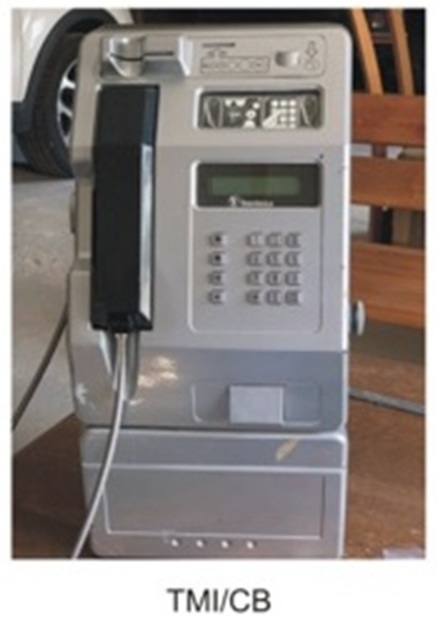
| Name | Teléfono público TMI-CB |
| Date | 2000 Very successful export model Note- the original matt grey version of the TMI CB was refined and reinforced by Telecom Australia into a new shiny reinforced stainless steel housing. This was used as the export model by Amper. |
| Manufacturer | Amper and later Infopyme Comunicaciones for use across across Spain and much of Latin America, especially under operators such as Telefónica, Movistar, Telefónica del Perú and Cuban telecom authorities. |
| Links | Amper TMI-CB in use in Australia Amper TMI-CB in use in Berlin Amper in use in Russia Amper TMI used in South Africa Amper used in Poland |


Development of the Teléfono público TMI-CB
The Teléfono público TMI-CB was originally developed in Spain during the 1990s by the telecommunications manufacturer Amper. Designed as a modular electronic public telephone, it represented a major technological shift away from older electromechanical coin telephones. The system used programmable tariffs, electronic diagnostics, smartcard operation, digital displays and remote fault reporting. The Spanish design emphasised vandal resistance, modular servicing and adaptability for different national telephone systems.
The platform became one of the most internationally successful Spanish public telephone designs of the late twentieth century. Variants of the same basic MPP architecture appeared across Europe, Latin America, Africa and Asia. Closely related versions were deployed in Spain, Germany, Croatia, South Africa, Malaysia, Singapore, China and throughout parts of Latin America. Some countries used primarily smartcard versions, while others retained coin mechanisms or hybrid systems depending on local telecommunications infrastructure.
The design could be customised with different housings, payment systems, keyboards, software and weather protection. In Germany, related units appeared under TELE-RUF branding, while Telefónica networks across Spain and Latin America adopted their own regional variants. The flexibility of the Spanish platform helped it compete internationally during the global transition from analogue public telephones to digital networked systems in the 1990s and early 2000s.

Below- the Reinforced SS version in Australia (left) and the original softer casing TMI CB original matt grey version. Note the different handset mount and screen configuration.


Below- Teléfono TMI CB in use in Cuba


Below- in use in Johannesburg South Africa

Below- in use in Argentina


Below- TMI CB in use in Croatia (stainless steel version)


Below- reinforced SS version in use in Australia 2026.


Leave a Reply