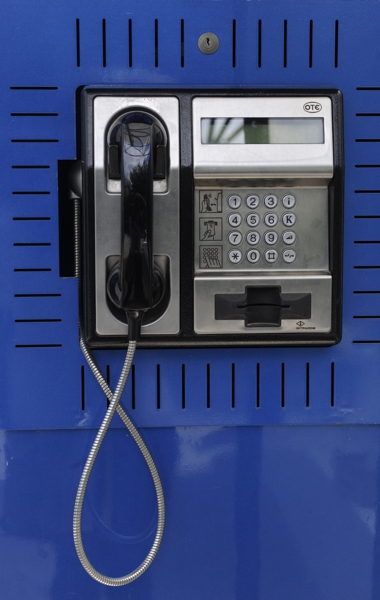
| Name | GNT-807 (Greece, Russia, southern European card phones) Card slot at bottom |
| Date | 1988–2010 |
| Manufacturer | GMT of Denmark |
| Links | GNT-502 as used in Sweden GNT-502 used in Russia |
Below- GNT-807 as used in Greece


GNT 807 payphones — Southern and Eastern Europe, c.1990s
The GNT 807 was a heavy-duty electronic public telephone developed by the Danish company GN Telematic/GNT Automatic, later marketed and supported through Ascom Nordic. It appeared during the 1990s as European telephone administrations replaced mechanical coin boxes with electronically controlled payphones.
Versions of the distinctive modular telephone were installed in Greece, Albania, Bulgaria and Romania, although surviving examples differ in colour, operator badge, tariff instructions and payment equipment. Strictly speaking, Albania, Bulgaria and Romania are better described as Southeastern Europe or the Balkans, rather than Southern Europe.
The GNT 807 was built around a strong, weather-resistant metal enclosure with a protected keypad, electronic display and armoured handset cord. Depending on the customer, it could be configured for coins, prepaid chip cards or locally specified payment systems. Its programmable electronics allowed national operators to alter tariffs without replacing the complete telephone. Later versions could also report faults, cash-box conditions and operating statistics to a central Payphone Management System.
The 807 demonstrates GNT’s success in exporting adaptable Danish payphone technology. The same basic platform could be given different keyboards, card readers, currency programming and operator graphics for each country. The model also travelled well beyond the Balkans: Ascom supplied a specialised GNT 807 RUS cardphone to Russia from the mid-1990s. Russian records identify its later manufacturer as Ascom Nordic, Denmark, and describe it as a prepaid electronic-card tariffing telephone.


The GNT 807 appears to have been particularly successful in Russia and the former Soviet market. Ascom began supplying Russia in 1994, and the GNT 807 became one of the principal foreign cardphones used during the modernisation of the Russian public telephone network. More than 1,500 were operating in St Petersburg by 1997, and by the early 2000s the St Petersburg network had around 2,000 GNT 807s. They also appeared in Petrozavodsk, Kaliningrad, Murmansk, Pskov, Novgorod and Cherepovets.
The model was therefore not specifically Russian: the GNT-807 RUS was a locally configured version of an internationally marketed Ascom platform. Its simple modular appearance, smart-card operation and centralised network management made it particularly suitable for countries replacing older coin-operated networks during the 1990s and early 2000s. Russian examples remained numerous into the mid-2000s, although they were increasingly supplemented by Ascom’s newer eXANTO models.
The GNT-807 consequently became part of the visual culture of post-Soviet Russia. Most famously, a GNT-807 is associated with Danila Bagrov, the protagonist of Alexei Balabanov’s cult 1997 film Brother (Брат). This connection has given the otherwise utilitarian payphone an unexpected place in Russian popular culture.
Below- these southern European payphones were made by GN payphone (Denmark) and deployed in Albania, Bulgaria, Greece, Romania, etc.


Leave a Reply