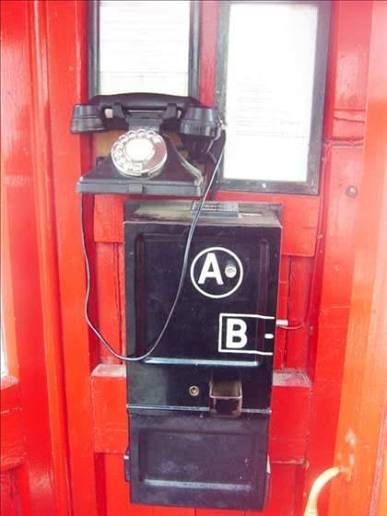
| Name | G110 coin box Multi-Coin AB |
| Date | 1930 |
| Manufacturer | Hall Telephone Co., Automatic Telephone Manufacturing Co. Ltd. (ATM), Siemens Brothers, and General Electric Company (GEC) |
| Links | AB MULTI COIN use in the UK AB MULTI COIN use in Australia |
Development of the G110 coin box in NZ

AB MULTI COIN NZ G110 coin box
The AB multi-coin box was designed primarily for after-hours toll calls. Previously, customers wishing to place long-distance calls outside normal Post Office hours had to visit a telephone exchange and speak directly with an operator. The new system allowed callers to use public telephones independently by depositing combinations of pennies, sixpences and shillings. Each denomination produced a distinctive sound as it struck either a wire spring or bell gong, enabling the operator to identify the value of the inserted coins simply by listening. Carefully engineered coin gauges rejected undersized or incorrect coins, while accepted coins fell directly into the cash compartment. The mechanism also temporarily connected a special carbon transmitter that relayed the coin sounds to the exchange. Although Britain had already developed combined local and toll multi-coin telephones, New Zealand initially intended these instruments solely for toll services.
Public Call Stations (1950s)
Following the Second World War, the terminology changed from “slot telephones” to public call stations. By 1953 there were 2,094 public call stations throughout New Zealand, increasing to 2,545 by 1956. These later payphones were progressively converted from one-penny operation to two-penny charging and increasingly supported toll (long-distance) calls. Revenue exceeded £189,000 annually by 1956, illustrating the enormous importance of public telephones before widespread private telephone ownership. The Post Office intended to provide toll services from every public telephone in the country, gradually modernising the entire network.
British Influence
New Zealand’s early payphones were heavily influenced by British Post Office practice. Contemporary British engineering allowed the evolution of public call offices, beginning with attended call offices before progressing to unattended coin-collecting boxes. These early coin boxes accepted only pennies and required the caller to turn a knob after inserting the coin, which signalled the operator. Around 1925, Britain introduced the multi-coin coin box, capable of accepting pennies, sixpences and shillings. This design formed the basis of later automatic public telephones and enabled unattended trunk calling. Similar technology and design principles were subsequently adopted in New Zealand.
Telephone Equipment
These kiosks housed several generations of payphones. Early installations contained simple local-call coin telephones before being upgraded to the familiar A/B button payphones. Later A/B telephones accepted multiple coin denominations, allowing users to make local calls, trunk calls and send telegrams. The operator listened for the distinctive sounds made by different coins passing through the mechanism before asking the caller to press Button A to deposit the money or Button B to receive a refund if the call was not completed. Following decimalisation, the coin mechanisms were modified to accept 2, 5 and 10 cent coins with minimal internal changes.

Leave a Reply